Email me with comments or questions to msuperfan1956@gmail.com – note that comments sent through Blogger DO NOT allow a personal response.

Showing posts with label Book Reviews. Show all posts

Thursday, June 25, 2026

Book Review - THE SUPERMAN WARS - by William Bernhardt


            This grand 2026 book is subtitled “A Battle for Truth, Justice, and an American Icon.”  The author, William Bernhardt, is a writer of several series of legal thrillers.  They’re always a fun read.  And extra credit because he’s an Oklahoman.

            This book is focused on Jerry Siegel, the writer half of the Siegel-Shuster team who created Superman and generated millions (maybe billions?) of dollars for almost everyone but themselves.

            Bernhardt does a good job of depicting the impoverished existence of sub-working-class children of immigrants to our country.  This was a world of neighborhood stores and craftspeople of the servant class, working to improve the prospects of their children.

            The author uses his tale-telling abilities to narrate the experiences of the young men who created the ultimate American hero.  It\s really depressing to read about the ongoing exploitation of their talent by all the various incarnations of DC and the men who ran them.  (The fact that such exploitation by those in power happens every day does not excuse it.)

            Joe Shuster is not shirked in the telling, but Jerry is in the spotlight throughout.

            In an afterword, Bernhardt ventures the opinions of a couple of psych/behavioral experts anent Jerry Siegel.  They point out that a lot of Jerry’s life exemplifies someone with hypomania or manic mood swings.  What achievements Siegel reached!—only to sign Superman away (more than once).

            The several legal imbroglios involving Jerry-and-Joe versus DC (and Jerry solo) show the dismal state of creators’ rights and corporate behavior.  Kudos to Neal Adams and others who motivated fans to shame DC into providing Joe and Jerry with medical coverage and pensions in the 1970s.

            I learned lots of things that THIS Super Fan did not know, including an early origin story for Superman which sent him to twentieth-century America from the future, not from another planet.

            The Superman Wars of the title are covered up until the 2025 film, with many backs-and-forths in courtroom and in the public eye.

            It’s gratifying to read the acknowledgments and see all the people Bernhardt contacted.  It’s like a Who’s Who of super folks, like Swan, Adams, the Siegel family, Carlin, Uslan, Maggin, and many more.

            This is a fine book with a splash of photos and art spread throughout.  If you love Superman, you’ll like it.  My only wish is that it were about half again as long and covered Joe Shuster’s side of the story in more depth.

            Read this book and enjoy some gosh-wows, and some deep compassion for how a couple of guys from Cleveland were swallowed alive by corporate greed.


            PS I was thrilled to meet Bill Bernhardt as a co-panelist at Soonercon 34, June 19-21, 2026.  He was kind enough to sign my copy of The Superman Wars.

            We participated in a panel called “The Golden Age of Sci-Fi: What Makes Classic Stories Endure?


            In this photo, left-to-right:  Bill Bernhardt, Steven Southard, Frank Hood, and me.

See you Monday!


Monday, April 13, 2026

You, Sir, Are NOT Harry Crews' "Car"!

Back around 1973, I read Car, an interesting read by Harry Crews, thanks to the New Arrivals table at the good ole Bartlesville Public Library.
This was more than fifty years ago.  I remember the absurdity of the premise, that, for a stunt, a guy promised to eat (suitably reduced to pieces) an entire car.  I'm sure the book is full of insightful characters and sharp commentary on consumer society, but I remember none of that.

I was amused when trying to recall the book, to come across a wacky image produced by the semi-fallible Google.  You know when you enter a search term, off to the right you would see other supposedly helpful, supposedly related info?

Check out the illustrated "preview" of Harry Crews' Car.  Ummm, I don't think so!

See ya Thursday for more silliness!
  

Thursday, February 26, 2026

You Too Can Be Bizarro!

This article is from the September 15, 2000 Oklahoman.
You can tell the writer had fun with the concept.

Of course I have this tome.  One thing about the whole Bizarro thing that I thought too much about was the whole do-the-opposite thing.  I mean, if you EXPECT a Bizarro to say "Good is Bad,"  wouldn't he say the OPPOSITE of that, that "Good is Good"?

If you expect a Bizarro to do everything wrong, wouldn't they get it right just to be opposite?  But then, if you EXPECT them to do that, then they'd have to do it wrong because you expect them to do it right, to spite your expectation that they would do it wrong ...

Do you have a headache yet?
  

Monday, February 23, 2026

Who Says Fantasy Isn't Ideal?

That's what Merle Fifield says in the opening paragraph, denigrating young people's thirst for a taste of otherworldliness.

Herewith is an article from the October 1966 English Journal, dug up in my 1970s college years from the OCU library.

Next we have the hobbits confronted with the military-industrial complex of Sauron.

When Fiefield says that the hobbits return home to find the Shire converted to a communist society, I also must disagree.  The terribly debased Shire is run by Sharkey (Saruman) in a similar manner as the bully-boy USSR, with all the goodies clasped by the bosses.  OK, I will concede that the USSR called their system "communism" or "communist socialism," so from the vantage of the mid-60s Fifield might have a point.
Fifield ends up deciding that Lord of the Rings is just a bit of harmless fantasy for the kiddies.  Some of must needs differ.  Tolkien's work is modern literature imbued with the age-old elements of myth:  heroes, failed leaders, small and important folk allied against a great evil ... What do YOU think of Fifield's comments?

It seems to me that as of 1966, Fifield had not yet learned that reality is a crutch for people who can't handle fantasy!
  

Thursday, February 19, 2026

Puttin' on the Berlitz

Charles Berlitz (1914-2003), among other things, was a breathless presented of capital-M Mysteries.  Here are a few of his tomes from my shelves.


Ya got a lot of speculation and recounting of it-really-happened anecdotes, which I don't recall because it's been decades since I cracked any of these covers.

Nevertheless, I can tell you with assurance that if you leave your BS detector at the door, you WILL be entertained by Mr B.

See you Monday, fellow Mysterians!
  

Thursday, December 25, 2025

A Charlie Brown Book Review


On December 9, 1965,our family was one of many who watched the first Peanuts TV special.

A few weeks later, I received five bucks from one pair of grandparents for Christmas.  That was a LOT of money for a nine-year-old in 1965!  That's about $50 bucks today.
When we drove to Tulsa (fifty miles away) in the week between Christmas and New Year's, one of the places we stopped was Louis Meyer's Bookstore.
And using my Christmas money, I bought a copy of A Charlie Brown Christmas, seen here and below in pix taken yesterday with my phone.  That rip you see in the jacket is all the way up and down; the jacket is in two main pieces.

Above are the book flaps.  Note the papers tucked behind the rear flap.
This is written in the front endpaper. I think it's my dad's printing.
Here is Mom's handwriting.  The book is "from" Grandpa and Grandma Whitley," but as I said, I bought the book with money they gave me.

When I bought the book, I remember Mr Meyer bending down and saying to Mom and Dad, "What a polite young man."  Boy, he didn't know me very well (as Bugs Bunny might say)!
What an honor to buy a book from the man I'd seen on TV!

I was in the fourth grade in December 1965.  Below is the book report I found tucked into the endpapers when I took the other pix.


That cursive's pretty good for a fourth grader!  PS I understand why I only got an "OK" on this.  Most of its length is verbatim quotations from the book.  And the concluding paragraph is kind of impersonal.  Still, the actual structure is not bad at creating an in medias res for Charlie Brown's moral crisis.

By the way ... MERRY CHRISTMAS EVERYBODY!
  
See you Monday.
    

Wednesday, October 15, 2025

The Countess Is Counting on You!

 Scary Books, Kiddies!


Countess Dracula. By Michel Parry. Beagle Books, 1971. “Based on the screenplay of the film.”

As you can tell, this paperback’s covers had a lot of flexing. I bought it at a thrift store on August 24, 1984, and subsequently used black magic marker to try and cover up all the cracks.

This restrained, aloof tome is the novelization of a sensationalistic 1971 film of the same name.

Of course, what everybody remembers from this movie is not the poster, but a certain image from elsewhere in the film, as reproduced below:

Obligatory "fangs for the mammaries" joke here ....

See you on Friday, fellow nibblers!
  

Wednesday, October 08, 2025

An Instant Paperback About the King of Monsters!


 Scary Books, Kiddies!


The Frankenscience Monster.  By Forrest J Ackerman.  Ace Books, 1969.  Cover painting by Verne Tossey.

            Rushed into print soon after Karloff’s passing, this fine little paperback is one of a long line of “instant books.”  Of course in ye olden days “instant” took awhile.  Everyone’s favorite “uncle monster” died on February 2, 1969.  According to Ackerman’s preface, “Farewell to the Master,” FJA got the OK from Donald Wollheim of Ace Books on March 7.

            This is a worshipful tribute to the gentleman of horror.  The book is an anthology of salutes and reminiscences from the likes of Chaney, Lee, Bloch, Bradbury, Glut, and many others.

            This is a fine production by “the world’s biggest sci-fi fan,” back when a sobriquet like that meant something.

            We salute you, Henry Pratt, and you also, Ackermonster!  See you on Friday, fellow Fiends!


Monday, July 28, 2025

Great Fun Nearly Ruined by Poor Production

I’ve read a dozen or so books by Kevin J Anderson.  I lo-oo-ove his Dan Shamble books.  The only one of his many tie-ins I’ve read was his take on Superman’s origins, which did not impress me as to being sanguine with the “true” roots of Superman.  Review here.

When we hosted Anderson in 2019 for SoonerCon 28, he was very friendly, witty, and insightful in person.  I bought ALL of the Shamble books from him, and he signed each one.

And, I’m an original Kolchak Kid, having watched Darren McGavin as Carl Kolchak in 1972’s The Night Stalker and 1973’s The Night Strangler on ABC’s Movie of the Week.  So when Anderson plugged this comics hardback, I immediately ordered.

Came to find out there is one comic-book tale of Kolchak and Dan Shamble in a crossover tale, several alternate covers, and two text pieces.

I am NOT disappointed with the art or storytelling.  But the editing-proofreading of this project is VERY disappointing.

The first tale is the Kolchak-Shamble crossover comic story, titled “Unnaturally Normal.”  It’s a lot of fun, although the basic plot and most of the characters are transferred from a nearly identically plotted tale, “Wishful Thinking,” in Anderson’s 2018 collection of Shamble shorts, Services Rendered.

First page, first panel, a goof!  Look at the opening text box, an opening voiceover if you will.  Note that the LAST letter at the end of the first three lines is the FIRST letter of the first word on the next line!  What’s up with that!?!?!?

Read Shamble’s speech balloons circled here.  Somebody repeated the same words in BOTH balloons.  It’s a sure bet that in the script for this page, Shamble IS NOT saying the same thing twice!

The first text piece, featuring Kolchak, is called “On the Wrong Bigfoot,” written by Richard Dean Starr and Matthew Baugh.  Everything seems OK with it.  It’s a fun first-person piece in which our favorite reporter and the long-suffering Tony Vincenzo have some interesting encounters with several aspects of conspiracy culture.

The second text piece, called “Digital van Helsing – The Fate Worse than Death,” is by Anderson and Guy Anthony De Marco.  Like the other tales, it is fun to read.  BUT … the presentation is amateurishly inept!

In several places we have what looks to be a rewording which includes TWO word choices.  The one above can’t decide what to do concerning breakfast— to “think about” breakfast, or “contemplate” it, so we got BOTH!

This happens several places, as above when the narrator can’t decide whether to name Marvin or leave him a “young man.”  But it gets WORSE!


Look at the above page.  See all the circles?  In each place there’s a random insertion of the numeral 1 and a bracket, thus: 1

This happens ALL OVER this last story.

Don’t you HATE it with the medium ruins the message?  Ta-ta, see you on Thursday.


Monday, June 30, 2025

Well, SOME of the Truth

Here's a clipping from the March 21, 1994 Tulsa World about the forming of what became known as the ARRB -- the Assassination Records Review Board.

If you wish to know more about the ARRB and its (lack of) findings, I encourage you to read the five-volume Inside the ARRB by Douglas Horne, one of the staff members.  Horne chronicles the cowardice and insight of several board members of higher rank than he was, and the attempts of some to make sure that no boats were rocked.

However, Horne explicates several important aspects of evidence that make the government's view (one or two shooters, no conspiracy, no government involvement) impossible to justify.  For one thing, the supposed autopsy photos and autopsy X-rays don't match each other, nor the recollections of either the autopsy doctors or Dallas doctors.

Read for yourself!  See you on Thursday.
  

Monday, April 14, 2025

In Books Be Silliness!

Herewith are a few things which amused me in reading some of the three-thousand-plus books I have logged.
From page 176 of Philip José Farmer's The Fabulous Riverboat, we have a sentence towards the end of the big paragraph, "They had more gall than France."  This tickled me because I think Farmer was joshing about Gaul, the Roman province which included France.  You're familiar with the opening words of Julius Caesar's The Gallic Wars?  "All Gaul is divided into three parts," or ""Gallia est omnis divisa in partes tres," as we learned in Latin Class.
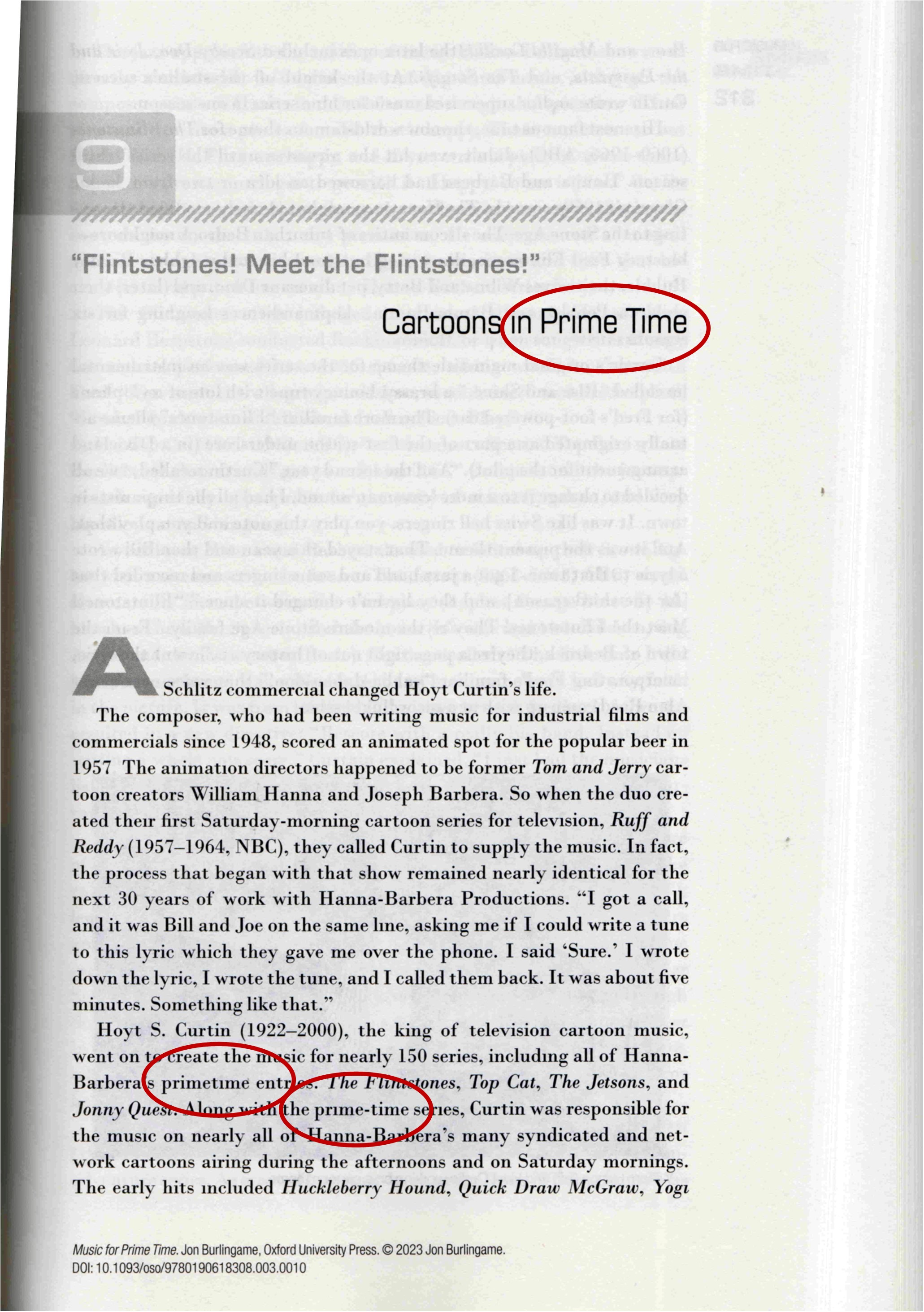
I don't know if a computer is to blame, but here in Jon Burlingame's great book Music for Prime Time, we have an odd hyphenation.  That is, an odd NON-hyphenation.  I mean ... aw, shucks!  Shouldn't that phrase be rendered the same way ALL THE TIME, especially in adjacent sentences?
In the 2020 spy thriller Black Flag by David Ricciardi, we are told that "a croc's jaws were the most powerful force in the mammalian world."  Somebody tell this guy that crocodiles ARE REPTILES, not mammals.  Sheesh!

Well, that's enough silliness for today.  See you on Thursday!
  

Monday, March 03, 2025

TimeTwist Tidbits!


SoonerCon 2009’s theme was “Slideways in Time,” and here are some of the text pieces I wrote for its Program Book.

“—All You Zombies—” is a science-fiction short story by Robert A Heinlein.  He dashed it off in a single day, July 11, 1958.  It was first published in the March 1959 issue of Fantasy and Science Fiction magazine.  In this story, the first-person narrator is his own father, mother, and child.

Timescape is a 1980 novel by science-fiction writer Gregory Benford.  In it, doomed scientists from a dying Earth (in 1998) try to send a warning message to the past, in 1962.  The interesting thing about the message is that it doesn’t involve travel as such.  The scientists shoot a tachyon beam to the astronomical position of the Earth in 1962 with their message.

In the 1986 comics maxi-series Watchmen, Alan Moore and Dave Gibbons describe an alternate Earth, deviated for the worse by the presence of “real” superheroics.  If superheroes were real, they’d really screw the world up, Moore said.

The Star Trek episode “The Naked Time” ends with a cold-fusion restart of the Enterprise’s warp engines, which accidentally sends the ship and crew three days backward in time.  Fan rumor has it that “The Naked Time” was originally a two-part story and script, with the time-travel ending of “Time” leading into the Enterprise’s accidental arrival in 1969 for the beginning of “Tomorrow Is Yesterday.”  The beginning of the aired version of “Yesterday” blames the Enterprise’s time travel on the slingshot effect of a black hole’s gravitational field.

In Mark Twain’s novel A Connecticut Yankee in King Arthur’s Court, the laconic Hank Morgan arrives in Camelot by simply waking up there.  At the end of the story, a jealous Merlin puts Morgan into a magical sleep until his own 19th-century time.

In Michael Moorcock’s Behold the Man, an agnostic named Karl Glogauer travels from the year 1970 in a time machine to 28 A.D., where he hopes to meet the historical Jesus of Nazareth.  Eventually Grogauer becomes the Jesus of history, with his words on the cross—“It’s a lie, it’s a lie”—misinterpreted by as “Telestai,” which is Aramaic for “It is finished,” or “It is paid.”

The Terminator films and TV series posit a future where machines have become sentient and systematically begin to eliminate humanity.  Who’ll change their oil? I wonder.


In Ray Bradbury’s classic 1952 tale “A Sound of Thunder,” the killing of a butterfly on a Time Travel Safari to kill a Tyrannosaur changes history, a presidential election, and the spelling rules of the English language.

When Harlan Ellison turned in his original script for Star Trek’s “The City on the Edge of Forever,” the Enterprise crewman who escaped to the planet was a drug dealer on the run from a Security team.  While in the past, Jim Kirk made the decision to live in the past with Edith Keeler (the future be damned).  It is Spock who prevents somebody else (not Kirk or McCoy) from saving Edith’s life.

          In a March 1986 episode of The New Twilight Zone, a story called “Profile in Silver” tells of a history professor from 2172, a distant descendant of JFK, who returns to Dallas 1963 as part of a time-travel research project.  But things go awry when Professor Joseph Fitzgerald prevents the assassination and is taken into custody himself.  He produces a silver 1964 half dollar and then time starts to fall apart.  The professor realizes that unless JFK dies, nuclear war will end life on Earth now, in 1963.

          In Superboy 85, cover-dated December 1960, a very young and inexperienced Superboy decides to change history by time-traveling to prevent the assassination of Abraham Lincoln.  However, in Washington DC he first encounters an adult time-traveling Lex Luthor, who whips out a piece of Red Kryptonite that paralyzes the super youth.  Only after a commotion in the street draws Luthor’s attention does the villain realize that Lincoln has been killed, and comes to the horrible conclusion that Superboy wasn’t time-traveling to apprehend Luthor but to rescue Lincoln.  Luthor has, in effect, murdered our 16th President.

Marvel Comics had several runs of a comic series What If? in which parallel-history stories wondered about what might happen if one or another piece of Marvel mythos were changed.  Topics wondered, “What if Spider-Man joined the Fantastic Four?” or “What if Captain America Became President?”

The 2004 film The Butterfly Effect focused on the idea that subjectively tiny incidents might portend large deviations in time.  Ashton Kutcher starred as a fellow enabled to time-travel along his own life.  Each “correction” he attempts leads to a disastrous conclusion.

Philip K Dick’s 1962 novel The Man in the High Castle is considered the fountainhead of alternate histories.  It matter-of-factly describes a North America carved up by the Japanese and Nazi Germany after the Axis Powers won World War II.

Several episodes of Babylon 5 featured the concepts of time travel or alternate outcomes, such as “War Without End” and “Babylon Squared.”

Dr Who’s TARDIS can travel anywhere and anywhen in time and/or space, depending on the skill of its pilot (and its maintenance schedule).  Don’t forget that TARDIS is an acronym for Time And Relative Dimensions In Space.

The perennial Christmas feel-good movie, It’s a Wonderful Life, is at its heart an alternative-history story.  What if George Bailey hadn’t been born?  How would Bedford Falls and its citizens be different?


The CBS comedy It’s About Time was a one-season 1966-1967 time-travel tale about a pair of US astronauts who end up in the Stone Age, which is populated by such characters as Joe E Ross and Imogene Coca.  Halfway through the (only) season, the astronauts returned to our time, accompanied by a Stone Age family.  This show’s premise allowed fish-out-of-water time jokes going both ways!

In 1966-1967, ABC provided a sci-fi show called The Time Tunnel, where two scientists became detached in time after the malfunction of the US government’s Project Tic-Toc.  Every week, while attempting to make their way home, they would end up in another crisis of times future or past.

Kurt Vonnegut’s 1969 Slaughterhouse-Five, or The Children’s Crusade: A Duty-Dance With Death is a post-modern anti-war science-fiction novel dealing with soldier Billy Pilgrim’s experiences during World War II and his journeys with time travel.  Somehow becoming “unstuck” in time, he wanders up and down his life’s timeline, living out Vonnegut’s deterministic and anti-free-will viewpoint.


In her 1971 novel The Lathe of Heaven, Ursula K Le Guin tells of George Orr, who turns to drugs to quiet his disturbing dreams.  Dr Haber, his therapist, discovers that Orr’s dreams, when directed beforehand, can alter reality.  So Haber decides to use Orr’s dreams to “fix” the world, in each instance ending up with a worse result than before.  The novel was adapted for TV, in 1980 and 2002.


There was a young woman from Bight
Whose speed was much faster than light.
So she set out one day
In a relative way,
And returned on the previous night.


As I was going up the stair
I met a man who wasn’t there.
He wasn’t there again today –
Oh how I wish he’d go away!


Robert Charles Wilson’s 1994 novel Mysterium concerns a county-sized chunk of America mysteriously transported into an alternate reality.  Here the world is ruled by a strange Catholic/Greek church-government and all independent thought and action is quickly stifled.  The transformation occurs in relation to a nearby military base’s experiments on a strange “quantum shard” from outer space.

See you on Thursday, fellow time travellers!
  

Monday, December 23, 2024

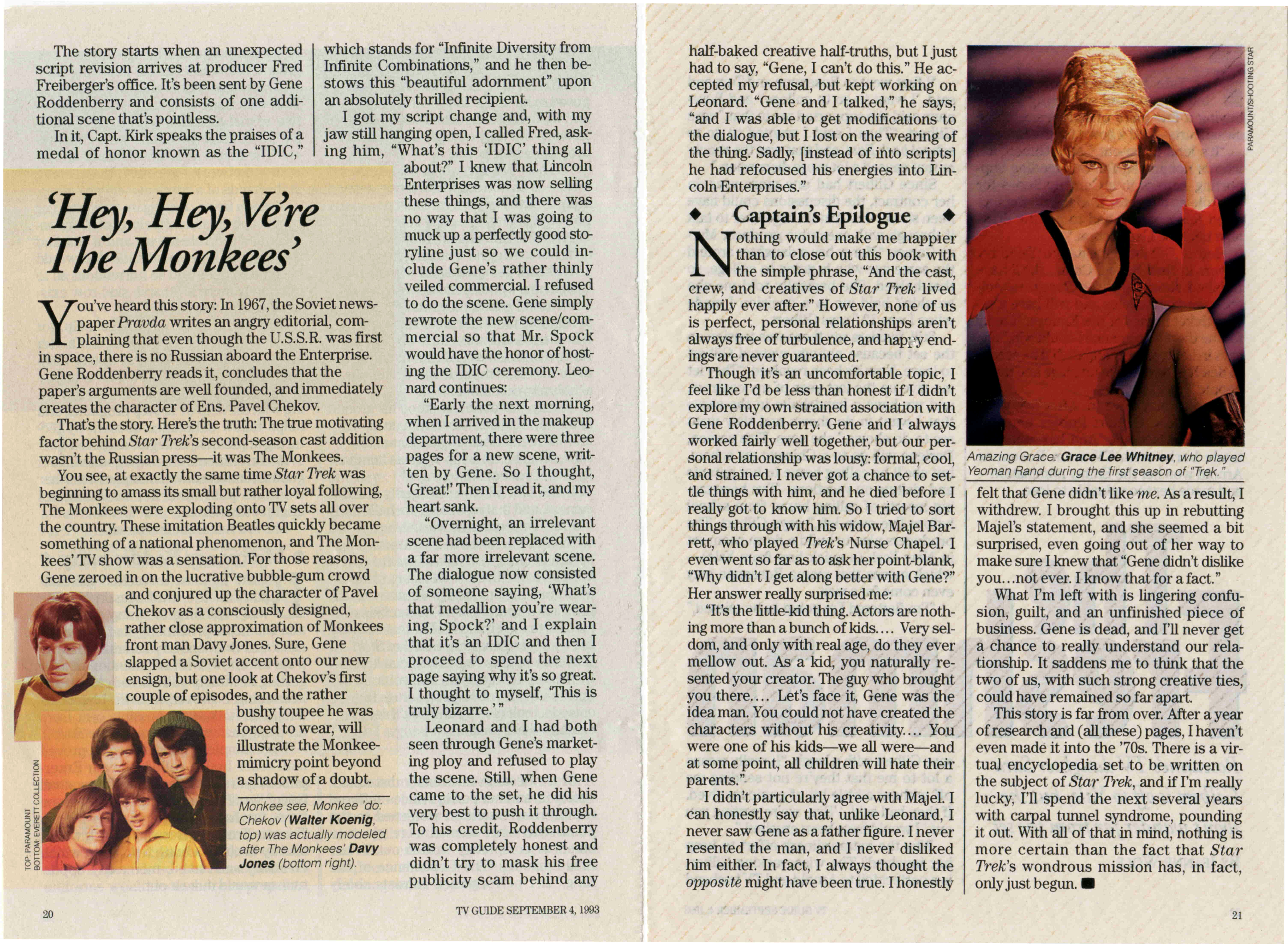
Somebody Else Has STAR TREK MEMORIES!

Here's an article from TV Guide about you-know-who and you-know-what.
This is the teaser from the August 28th issue


This is the story from the September 4, 1993 issue.
And these letters were printed in the September 25 issue.

See you Thursday!
  
All original content
copyright
© by Mark Alfred