


Nothing old-fashined about love, though. I hope you have some! See you Monday for the final round of this year's MY SIXTIES VALENTINE! Dare we say it --- It's a DATE!





I’m
all for commonsense - in certain situations, but I’ve always got time for a bit
of wild, uninformed speculation. And what better to speculate wildly about,
from the comfort of your armchair, than the vast, unexplored interior of our
own planet? Sure, boring scientists tell us that the earth is solid, that
there’s nothing down there but rock and a lot of rather frightening red-hot
magma, but then, to borrow the immortal words of Mandy Rice-Davies, “They
would, wouldn’t they?”
Such
was not always the case. Cosmological theories involving a hollow earth were
part of orthodox science until the late 18th century. In 1692 British
astronomer Edmund Halley - he of comet fame - in an attempt to explain
variations in the measurements of the North Magnetic Pole, proposed a world
made up of four concentric spheres, one inside the other, each separated by an
atmosphere, and all turning about a common axis but at slightly different
speeds. In a speculative mood, Halley went on to wonder whether each of these
spheres might support life, just as the outer sphere supports us. For Halley,
as for many of the early hollow earthers, one of the reasons for such
speculation was a simple one if somewhat puzzling to us today - economy. God,
they reasoned, would surely not waste the vast interior of a planet by filling
it up with rock. (This reminds me of the doddering old Christian Brother I once
had as a history teacher, who solemnly told us that the pyramids were so big
the Egyptians would not have wasted them on just one pharaoh each.)
Advances
in physics and geology soon made theories like Halley’s untenable. That left
the business of promoting a hollow earth to enthusiastic amateurs, the first
and most enthusiastic of them all being an American named John Cleves Symmes.
An ex-soldier and frontier trader, Symmes retained Halley’s concentric spheres
separated by an ‘aerial elastic fluid’ but added his own idea of twin openings
at the poles (the one at the north pole being 4,000 miles in diameter). These
holes were joined so that the earth was in effect shaped like a doughnut, and
it was possible to sail into the openings and reach the inner world.
In 1818 Symmes distributed a circular throughout America outlining his ideas and requesting funds to mount an expedition - to be led by him - into the northern opening. Undeterred by the ridicule with which this was generally met, the single-minded Symmes spent the next few years lecturing and hectoring, picking up some prominent supporters along the way (no less than nine petitions advocating Symmes’s expedition were debated by Congress). After his death his work was carried on by his son, Americus, who was big on the idea that the interior world was inhabited by the Lost Tribes of Israel.
Other
hollow earthers followed in Symmes’s wake. One of the more indefatigable was
Marshall Gardner, a sewing machine manufacturer whose masterpiece, A Journey to
the Earth’s Interior; or, Have the Poles Really Been Reached? appeared in 1913.
Gardner kept Symmes polar openings but jettisoned the system of concentric
spheres, believing instead in the earth as a hollow bubble equipped with an
interior sun. Gardner, in Jules Verne mode, wrote vividly of an internal world
bursting with lush vegetation and roamed by animals such as mastodons which
were thought to be extinct. As with many of the early hollow earthers, one of
Gardner’s main themes was that here was a vast amount of land ripe for
colonisation by the United States.
Gardner lived long enough to
see both north and south poles reached - in 1911 and 1913 respectively - but
went to his grave believing that instead of reaching the poles (which of course
he did not believe in), the explorers had simply wandered aimlessly around the
rims of his vaunted polar openings.
Meanwhile the theory of a hollow earth had been given a
novel twist by the social visionary Dr Cyrus Teed. He too postulated a hollow
earth warmed by a central sun, but then went on to suggest that we are actually
living inside such a globe. This is what is known in Hollywood as a ‘high concept’.

Teed,
who was born in 1839, was a doctor of what would now be called alternative
medicine and a dabbler in ‘electro-alchemy’. One night he was sitting in his
alchemical laboratory in New York, pondering the mysteries of the universe,
when he had a strange and erotic vision. A beautiful, golden- haired,
purple-robed woman appeared who told him he had been reincarnated many times -
once as Jesus Christ - and revealed to him the secrets of the cosmos. Teed (as
Vernon Howell of the Branch Davidians would do many years later) adopted the
name of Koresh (Hebrew for Cyrus), and began preaching his revelation to his
patients, most of whom thought him unhinged. Undaunted, he moved to Chicago and
during the 1880s acquired a large number of - mostly female - followers,
attracted by the man’s magnetic personality.
There
was a lot more to Teed’s ideas than an eccentric cosmology. Like many 19th
century idealists he dreamed of setting up a utopian community, a New
Jerusalem, the capital of the world. His opportunity came in 1890 when a German
settler In Florida was persuaded to sign over 320 acres on Estero Bay to the
Koreshans. Teed moved about a hundred of his followers there and set up the
Koreshan Co-operative and Communistic Society, run, as its name suggests, on
communist lines. Alcohol and tobacco were forbidden and celibacy was
recommended for the community’s upper echelons. Women occupied an exalted
position in Koreshanity. The community was ruled by Teed, his longtime
companion Anna Ordway, whom he had renamed Victoria Gratia, and a council of
seven women representing the seven planets. (The fact that the majority of
Teed’s followers were women led, not surprisingly, to allegations of sexual
impropriety on his part, but for once these seem to have been unfounded).
Teed’s community prospered, with its population reaching 200 by the turn of the
century.
According
to Teed’s cosmology, the sun, moon, stars, indeed everything we can see is
inside the earth and outside there is - nothing. It was all quite literally a
return to the womb - that of the earth goddess, the beautiful girl of his
vision. Teed nevertheless continued to think of himself as a scientist, and
cast about for some proofs. To this end, a device called the Rectilineator was
constructed out of large T-squares, and over several months in 1897 experiments
were carried out with it which proved that the earth was indeed, as Teed’s
theory required, concave. A large sign above the entrance to the Koreshan
community proudly proclaimed “WE LIVE ON THE INSIDE”.
Teed’s
mistake was to go into politics. Growing dissatisfied with the Democrats, for
whom he had previously instructed his followers to vote, he formed the
Progressive Liberty Party, which began to look like it might do well in the
1904 election. The tensions this caused led to a public brawl between Koreshans
and some locals, during which Teed was beaten about the head. He never fully
recovered from his injuries and died three years later. His followers,
expecting his body to undergo ‘Theocrisis’ (i.e. disappear in a flash of
electro- alchemical light), laid it in state and watched, only to see it
decompose. Eventually the health authorities forced them to bury it, and the community
Teed had founded went into a slow decline.
While
soon forgotten in America, Teed’s ideas had a second lease of life in Germany
when several issues of a Koreshan magazine fell into the hands of an ex-WWI
pilot, Peter Bender, who was so taken with them he came to believe he too was a
reincarnation of Koresh. He began to promote the ‘Hollow Earth Doctrine’ or
‘Hohlweltlehre’ vigorously, aided by the fact that he was friends with several
high-level Nazis including Herman Goering. In 1933 an engineer named Mengering,
who lived in the city of Magdeburg in Prussia, conceived an experiment to test
the theory. His idea was a simple one. If we indeed live inside a hollow
sphere, then a rocket launched vertically from Germany would, if it travelled
far enough, eventually land in somewhere like Australia. Mengering obtained
financial assistance from the city council and the help of several rocket
experts from Berlin. Unfortunately rocket technology in 1933 wasn’t quite up to
this experiment and when, after several test flights, a projectile was launched
on 29 June it travelled vertically rather than horizontally (it must have
provided a good day out for the locals though). The Hollow Earth Doctrine was
put to the test at least once more ten years later. With Germany desperate for
new weapons to win
the
war, the Naval Research Institute financed a study into the theory’s naval
applications (the idea here being that, if the surface of the earth is concave,
objects at a distance - including enemy ships - might be detected by pointing a
sufficiently powerful telescope at the sky.) When the results of these
experiments proved less than promising, the Nazis apparently lost patience with
Bender, and soon afterwards he and his family were carted off to a
concentration camp where they perished.
In
1959 Ray Palmer, who had made quite a stir in the ‘40s by publishing Richard
Shaver’s stories about an underworld race of evil, hypnotising dwarfs called
deros (See ‘Of Teros and Deros’ in Bizarrism #5), began to promote the
idea that flying saucers came not from outer space, but from the interior of
the earth. His chief piece of evidence for the existence of polar openings -
from which UFOs emerged - was the claim that famed polar explorer Admiral
Richard E. Byrd, in expeditions in 1947 and 1956, had flown over the north and
south poles and found lands ‘beyond’ them, facts which Palmer claimed the
government had suppressed. Byrd had indeed been on expeditions in these years
(although they had in fact both been to the south pole) but the tale of polar
openings seems to have been made up by one F. Amadeo Giannini, who wrote about
it in his book Worlds Beyond the Poles. This tale has proved to be an extremely
tenacious one. What was purported to be Byrd’s uncensored log of the north pole
trip was published as a book in 1990, and excerpts from it continue to pop up
in alternative and conspiracy magazines. In the log, Byrd describes flying over
rolling green hills and spotting what looks like a mammoth. Suddenly, flying
saucers appear, emblazoned with swastikas! Byrd’s plane is forced to land and
he is met by several blonde, German-speaking men who take him to a glowing
‘crystal city’. Here he meets the ‘Master’, who says that they have been
observing ‘our race’ and warns Byrd that we are on a path to atomic
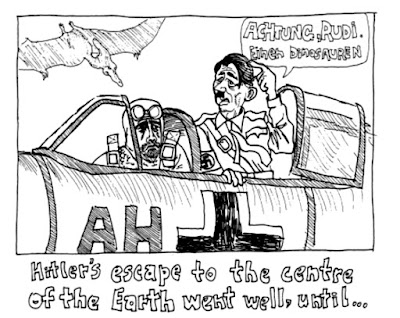
destruction. (Byrd had obviously wandered into a variation of the idea that a
group of Nazis - usually including Hitler - had escaped Germany in secretly
developed flying saucers or ‘fluegelrads’ and were hiding out beneath the
Antarctic.)
A personage with the grand title of the ‘King of the World’ had appeared to them
to deliver a great prophecy - a tale of coming wars and tribulations which
would only end when the King and his subjects emerged from Agharti to bring
about peace. Variations of this story have been kicking round for years. In the
Nazi version, the city becomes the home of evil Tibetan monks who helped Hitler
in his rise to power in the ‘30s.
The
supposed polar discoveries of Admiral Byrd figure largely in Dr Raymond
Bernard’s The Hollow Earth (1963), which is the best-known book on the subject.
Bernard - a pseudonym for Walter Stieglitz - was a health food crank and
confirmed celibate who had been warning people of a coming nuclear holocaust
since the ‘50s (he lived on an island off Brazil which he claimed was outside
fallout range). He also dreamed of a super race of females who reproduced
parthogenetically, and came to believe they lived inside the earth. Bernard’s
attempts to sell land on his island were seen by some as little more than a
real estate scam, but it seems that Bernard genuinely believed in the interior
world, and himself suffered at the hands of conmen who claimed they could show
him a way into it.
Whatever
science may say about it, the hollow earth is such a neat and satisfying
concept it’s unlikely to ever disappear. A recent story doing the rounds of the
New Age press told of a 1991 international expedition to the north pole led by
Danish scientist Edmund Bork, which had passed through a polar opening and
found a land of tropical vegetation, lit by its own sun, with a warm shallow
sea and a peaceful population of humans - the ideal holiday destination in
fact. Let’s face it, we live on the skin of a large rock hurtling at
unimaginable speeds through a vast, cold, mysterious and potentially dangerous
universe. Wouldn’t it be nice to go inside?


