I hope you got some super swag to wear to dreamland! See you on Monday to begin a month of compilations!


I’ve read a dozen or so books by Kevin J Anderson. I lo-oo-ove his Dan Shamble books. The only one of his many tie-ins I’ve read was his take on Superman’s origins, which did not impress me as to being sanguine with the “true” roots of Superman. Review here.
When we hosted Anderson in 2019 for SoonerCon 28, he was very friendly, witty, and insightful in person. I bought ALL of the Shamble books from him, and he signed each one.
And, I’m an original Kolchak Kid, having watched Darren McGavin as Carl Kolchak in 1972’s The Night Stalker and 1973’s The Night Strangler on ABC’s Movie of the Week. So when Anderson plugged this comics hardback, I immediately ordered.

Came to find out there is one comic-book tale of Kolchak and Dan Shamble in a crossover tale, several alternate covers, and two text pieces.
I am NOT disappointed with the art or storytelling. But the editing-proofreading of this project is VERY disappointing.
The first tale is the Kolchak-Shamble crossover comic story,
titled “Unnaturally Normal.” It’s a lot
of fun, although the basic plot and most of the characters are transferred from
a nearly identically plotted tale, “Wishful Thinking,” in Anderson’s 2018
collection of Shamble shorts, Services Rendered.


Read Shamble’s speech balloons circled here. Somebody repeated the same words in BOTH balloons. It’s a sure bet that in the script for this page, Shamble IS NOT saying the same thing twice!
The first text piece, featuring Kolchak, is called “On the Wrong Bigfoot,” written by Richard Dean Starr and Matthew Baugh. Everything seems OK with it. It’s a fun first-person piece in which our favorite reporter and the long-suffering Tony Vincenzo have some interesting encounters with several aspects of conspiracy culture.
The second text piece, called “Digital van Helsing – The
Fate Worse than Death,” is by Anderson and Guy Anthony De Marco. Like the other tales, it is fun to read. BUT … the presentation is amateurishly inept!

In several places we have what looks to be a rewording which
includes TWO word choices. The one above
can’t decide what to do concerning breakfast— to “think about” breakfast, or
“contemplate” it, so we got BOTH!


This happens ALL OVER this last story.
Don’t you HATE it with the medium ruins the message? Ta-ta, see you on Thursday.




After the
end of Star Trek’s run, Gene Roddenberry pitched several projects to
the TV networks—to be honest, it was one idea, continually redressed. All were
set on a future Earth, in the aftermath of a planetwide war. The TV-movie Genesis
II aired in 1973, and starred a 20th-Century man awakening
in 2133 in an Earth populated by splintered outposts of mankind. A reworked
version, Planet Earth, aired in 1974. A third telefilm based on the
concept was broadcast in 1975. Its title—Brave New World.
Miranda is the daughter of the sorcerer Prospero in Shakespeare’s The Tempest. When some mariners are shipwrecked on their barren island, she begs her father to save them. She eventually marries one of the refugees, the prince of Naples. In the play’s final scene, she addresses the crowd who is celebrating the nuptials:
O wonder!How many goodly creatures are there here!How beauteous mankind is! O brave new world,That has such people in't.
Some pop groups have given the phrase “Brave New World” a sarcastic spin. Jimmy and the Boys’ 1981 “Brave New World” narrates a society populated by genderless workers whose mindless activity feeds the machines of progress. “Brave New World” by the Tender Violent Chords, from 1982, looks forward to spaceships and satellite eyes that watch the world without emotion.
Some “new worlds” aren’t that great. Aldous Huxley’s dystopian look at a fascist future, the 1932 novel Brave New World, was a satirical riposte against the utopian dreams of H.G. Wells. In the future of Huxley’s tale, bottle babies and strict social castes are the norm. Technology’s sole aim is to keep the lower classes occupied so that the upper castes may indulge their government-sanctioned fancies. Huxley’s satirical title was a direct reference to Shakespeare’s The Tempest.

Ray Bradbury’s 1953 dystopian novel Fahrenheit 451 foresaw a future in which independent thought is stifled through the suppression of books and learning. Bradbury originally said that the book was conceived in reaction to the McCarthy hearings’ chilling effect on free speech. In 2007, he revised his opinion to say that the book’s allegory also applies to mass media’s effect in reducing consumers’ interest in reading and literature.

Some of the current organizations that claim to be working on a wonderful future world are the World Future Society; the World Future Council (offices in Hamburg, London, and Geneva); and the Future Worlds Center (based in Cyprus). Don’t forget the Association of Professional Futurists, or the World Futures Studies Federation, founded in 1973. Or our own Future Society of Oklahoma!


WATCHPANELS
One compulsive reader’s observations ...
after gazing into Watchmen for the umpteenth timePart the Eleventh
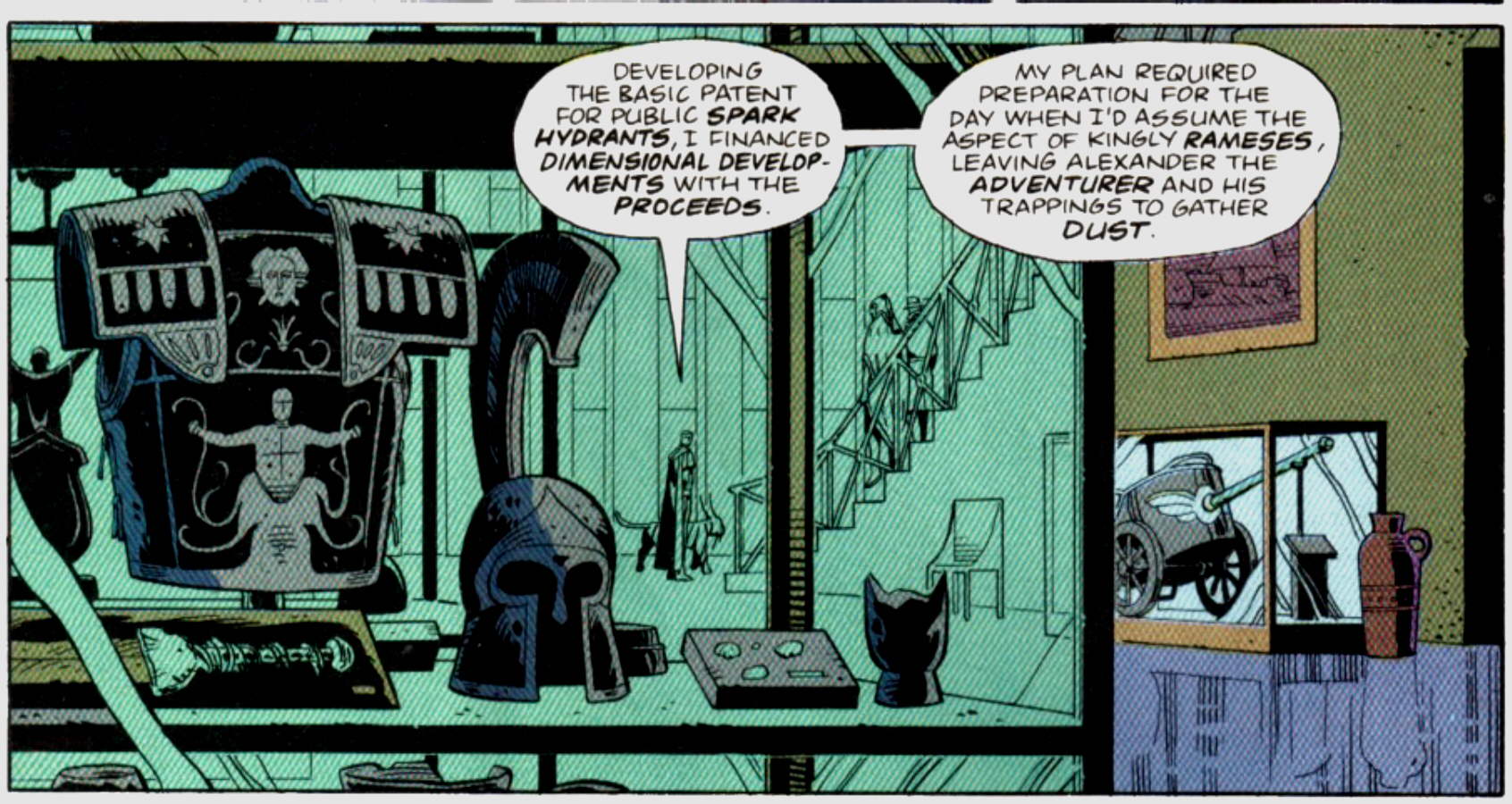
All right, I’ve got photons in my teeth and my wrist brace on ...