Regarding music posts: PLEASE NOTE that since my previous host FileFactory has made itself useless, I am slowly but surely updating to DRIME. Please be patient, and email me with comments or questions to msuperfan1956@gmail.com – note that comments sent through Blogger DO NOT allow a personal response.

Wednesday, April 17, 2013

Music That's Super!


Here we have another compilation disc, of Super themes & variations. Nothing but DC's Main Man (and I don't mean Lobo). It comes complete with am amateurish "LP-to-CD" statement that was probably unnecessary.

Anyway, these are what's in there:


1) Movie Theme - Walter Murphy
2) Superboy TV Theme
3) Superman - Herbie Mann
4) The Adventures of Superman TV Theme
5) Sound from Krypto / Movie Theme - Let's All Dance with Super Friends cassette
6) Superman the Animated Series TV Theme (extended)
7) The Batman / Superman Adventures TV Theme
8) Movie Theme - Gotham's Greatest
9) Comic Book Heroes / I'm Your Superman - Rick Springfield
10) The New Adventures of Superman TV Theme
11) The New Adventures of Superman Episode Title Music
12) The New Adventures of Superman TV End Credits
13) Movie Theme - Super Hero Music cassette
14) It's Superman - The Supermen
15) You've Got Possibilities - The Supermen
16) TV Theme - Ruby-Spears
17) Movie Theme - Cinema Sound Orchestra
18) The Superman / Batman Adventures TV Theme
19) Superboy TV Theme (Filmation cartoon)
20) SuperPup TV Theme
21) Movie Theme - Fleischer cartoons
22) Theme from Superman (original) - Wonderland Space Shuttle
23) Movie Serial Theme

Most of these are the fruit of decades of thrift-strore digging. Hope you enjoy the result .


See ya!


Monday, April 15, 2013

We Don't Know What Happened Long Ago

Here are more covers from my library of 1100+ books.  These have a theme of "Mysteries from the Past."


In the de Camps's book, we learn about the wonders of places such as Maccu Pichu, Stonehenge, the plain of Giza, and many more.
 
This book is also known in paperback as Citadels of Mystery.
 
The de Camps were wonderful people, if you can judge from ten minutes' interaction at a convention in the 1990s.  The book is non-speculation, but a descriptive one.  The wonder you feel is simply amazaement that people (whatever theis technological level) were able to figure out and build these things.  Always insightful and witty, the de Camps are the way to go when you want just the facts, ma'am.


Now, the Bords are very mystical and veddy, veddy British.  They love to give you mist-covered landscapes.  This book is very much in the school of ley lines and cosmic siginificance.


This book talks about mysteries such as the famous chimney tower in New England that is ascribed to the Vikings but is older (it's like Dr Fate's tower with no doors), and the so-called "Indian" mounds of the Mississippi Valley, and other things.  Of course some of those mounds were designed and built by American Indians, but some are older and, well, strange.  This book looks at things like that.
 
 
Now go out there and READ!  Just not Erich von Däniken...he's too silly.
 

Friday, April 12, 2013

More Funny Suggestions from Amazon


The above suggestions are more reflections of the idea that if I want to see an art book about 1950s America, then I must be in the market for medical supplies because obviously I am expecting Nuclear Winter any second now.  (Don't tell North Korea).


I think I've figure out these two textbook-type suggestions.  Note that they are based on my buying a book on Superman that is part of a series "Icons of America."

I bet you that SOMEWHERE the "Icons of America" series is part of the reading list for a college class.  Which makes it a textbook and therefore Amazon figures I want to buy EVERY OTHER textbook they sell!?!?


Monday, April 08, 2013

Part the Fourth


Best Friend Ever!

 
            Our housing development, Pennington Hills, was built in the middle-to-late 1950s, and most houses were GI-loan houses.  At least ours was.  Many of the houses had the same floor plan.  Across the street from us, the house was mirror-flipped but otherwise identical.

            Soon after my folks moved in at my birth in 1956, the Hefners moved in across the street.  At our house, Robert was the oldest, then Sue, a year younger, then me, nine years younger than Robert and eight years after Sue.  At the Hefners’ house, Debbie was the oldest, then Pam a year or two younger, then Tommy, who was about six months younger than me and therefore in the next-lower grade.  I think the age spread between the Hefner kids may have been about six years.

 
            Anyway, I grew up with Tommy as my soulmate.  Ray Bradbury wrote something similar in describing Will Holloway and Jim Nightshade in the classic novel Something Wicked This Way Comes -- that they had their fingerprints in the Play-Doh of each other’s souls, or some such.


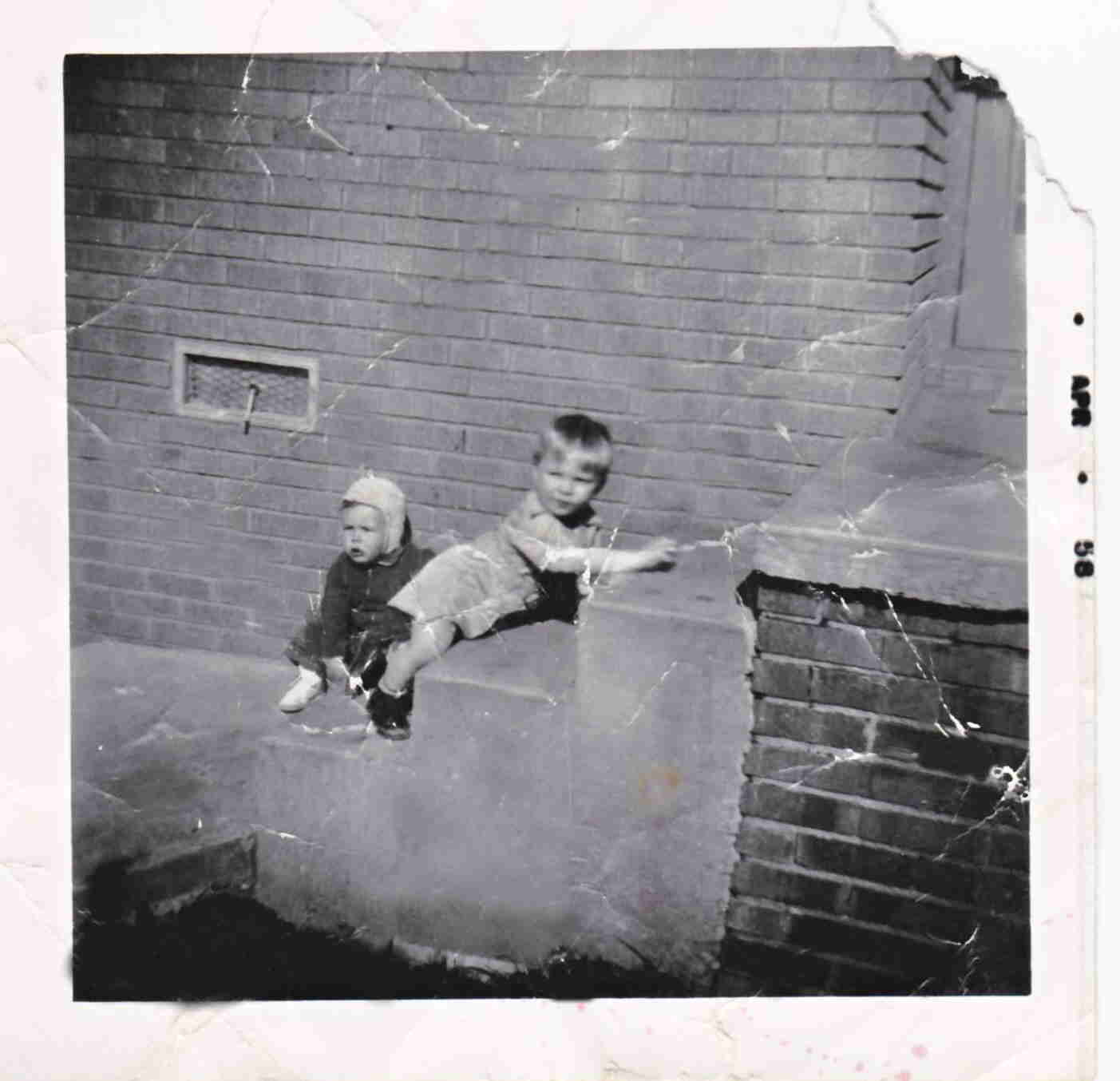
            In this photo we are on the steps of the Hefner house.  Tommy’s the one all bundled up while I look like Red Skelton’s “Mean Widdle Kid.”  I am about 1½ years old and Tommy just turned one.

            The story goes that I used to push Tommy off the porch until he got big enough to push ME off.  After that we got along better.

             When we were in second and third grade, we would play Superman (after the George Reeves syndicated show).  At that time, Tommy wore glasses and I didn’t.  So, he got to be Clark Kent/Superman.  Hardly seemed fair.

             By the time we were around eight years old, Tommy had spent a year wearing an eye patch for amblyopia (aka “lazy eye”) and no longer wore glasses.    However, I then needed them. 
             The sensation of wearing glasses for the first time was disturbing.  I had ridden my bike up to Dr Fooshee’s office to get my first pair when they arrived.  My perception was so different that when I hopped on and pedaled away, I tumbled my bike two or three times before I got used to seeing things in a new way!  When I was much younger, Mom had let me wear her glasses for a few seconds.  The floor as perceived through her lenses was about a foot higher than it really was, and I kept trying to step up to it!
 
            Anyway, now I was the glasses wearer and Tommy wasn’t.


            In 1968  we went to the Tom Mix Museum in nearby Dewey, OK.  In between?  We played nearly every day together.  On Saturday mornings, whoever woke up first would get dressed, dash across the street, and scritchy-scratch on the others’ window.  We rode our Sting-ray-style bikes everywhere.

            In our neighborhood, the garage floors were somehow more polished and smoother than the driveways.  When we spotted an open garage door and empty space within, we would whip into the driveway and into the garage, hitting our coaster brakes and leaning into the skid.  We could whip a perfect 180-degree turn and end up still upright with our feet down on each side of the seat.  This was our patented Bat-Turn.


            Speaking of Bats … When Batman came on for its two nights a week, one night it would be at my house, and the next at Tommy’s.  His parents were gracious enough to let him keep an HO car set on the floor of the living room by the sliding porch door, and we would wipe out on the HO track as we watched the Riddler or King Tut get decked by Batman and Robin.

            When it came to role-playing, I was at another disadvantage when The Man from U.N.C.L.E.  swarmed into our ken.  When we played U.N.C.L.E., Tommy was blond while I had dark hair.  That meant that HE got to play the cooler guy, Illya Kuryakin.

          Then, in 1969, my world ended.

More on that later.


Sunday, March 31, 2013

Monday, March 25, 2013

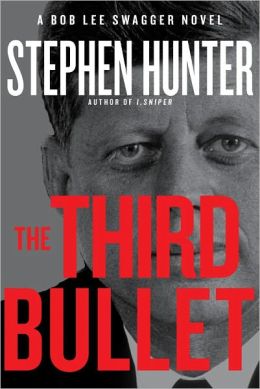
Book Review -- The Third Bullet by Stephen Hunter


            This is another of those fictional takes on history, laying out a possible explanation of the JFK homicide.  The main character of the book, Bob Lee Swagger, is evidently a franchise character for Mr Hunter, though I don’t know any of the author’s other seventeen books.

            Swagger is a seventies-something guy who is asked to investigate the hit-and-murder of a guy; this leads him into the JFK mess.  “The Third Bullet” of the title is a Mannlicher-Carcano bullet mounted on the cartridge of a very accurate rifle fired by a super-marksman from the Dal-Tex building, with Oswald as the patsy, LHO thinking that he himself is an assassin run by a Russian agent.

            The idea is that a top-of-the-line American spymaster is worried that (ex) General Edwin Walker, that right-wing agitator, will gain enough influence to drag the country into a full-fledged Vietnam war.  When puppetmaster Meachum learns that Oswald in his attempt to emigrate to Russia/Cuba claims to have taken the April 10, 1963 shot at Walker (it missed), Meachum decides to enlist him to try again and do it right.  This would eliminate Walker as an agitprop agent of the warmongering, Red-baiting Right Wing. 

            (HUMOROUS ASIDE:  I think it amusing that Microsoft WORD allowed the use of the word “agitprop” without suggesting a correction.  In other words it’s in MS WORD’s basic dictionary.)

             It’s simply a coincidence that Oswald happens to work at a building that JFK’s motorcade is scheduled to pass in front of.  So when the JFK route is announced, Meachum decides to up the ante.  Instead of killing Walker to try and forestall a Vietnam conflict, why not kill the president who might implement it?   Besides, Meachum is certain that LBJ would never have the gumption to enter into such a shootin’ war.  (History tells us how that idea worked out.)

            When our hero Swagger starts to unravel the big ugly ball of twine, the now-retired spy decides to shut him down, too.  And so a battle of wits transpires.

            While this is an interesting book and a perfectly absorbing tale, is is lacking in several aspects when compared to the historical events it attempts to “explain.”

             The first thing that bothered me is just an opinion, I guess.   This book’s depiction of Lee Oswald is second only to Stephen King’s 11/22/63 in depicting Oswald as a petty, venal, loser screw-up whose only use to the world was as a patsy.

            Now, I don’t know whether a psychological/behavioral analysis of LHO would disprove this description,  but still!  It is the epitome of author-as-bully to describe somebody this way.  It’s like drawing a mustache on a portrait that you yourself are painting!  Oswald might have been a creep for real, but the hatred that drips from the pen in these one-sided characterizations reminds me of a thirteen-year-old teenage girl with acne, all alone on prom night, drawing “XXX” across the yearbook picture of the popular girl while saying to herself, “THAT will fix her!”.  Such abuse of the writer’s craft shows a streak of pettiness in the writer, in my opinion.

            Of course, the author of this book and Mr King of Maine both feel justified because, IN THEIR VIEWPOINT,  Lee Oswald REALLY WAS the King-Killer, at least in intent.  This makes him fair game for authorial bullying, I guess.  Surely such an obvious thing was noted by editors and commented on.  Was this characterization intentional, anyway? or did it drip unbidden from an authorial unconscious? 

            I am sure that there is a fraction of the American people that believes that we would now be living in the Millennium, if only that rat-bastard Oswald had not slain the Golden King and allowed that other rat-bastard LBJ to ruin everything.  But this is an emotional viewpoint, an article of faith, that may lie unexamined in the bedrock of some folks’ feelings.

            In mine own views, this is really more the mark of a foaming-at-the-mouth hate-speech-writer than the attributes of a novelist whose work I want to read more of.

            As elegant as Mr Hunter’s theory-of-assassination might be, it lays out the events as an improvised hit by elements already in place for a hit on General Walker, a team whose boss is stuck by inspiration when learning that JFK is comin’ to town.

            The problem with this idea is, it doesn’t explain the elements (before and after the hit) that were undertaken by other people to fake and obfuscate.   

·         The imposter Secret Service agents on the Grassy Knoll. 
·         The replacement of the limo’s windshield before it could be investigated as evidence. 
·         The funny business with the autopsy and the forging/replacement of government records/photos/x-rays. 

 
            All of these things (and lots more) remain unanswered by the limited-hang-out scenario presented by Mr Hunter.

            So, as a book it’s interesting and well constructed.  As an alternate theory it’s about 50 percent short.  And its depiction of Oswald shows the worst sort of authorial bullying.

What do YOU think?


Thursday, March 21, 2013

More Silly Amazon Suggestions


I don't know why I need a combination suture/needle, but maybe because I like an art book about the Cold War, Amazon figures I will lose a finger...


And I don't know what an Emmylou Harris album has with Sherry Fiester's  fascinating book , Enemy of the Truth.  The book is a forensic anyalyst's look at some of the known aspects of the JFK murder.  And the recommendation is a "country" album.  Huh?

PS, note the uncomfortable abbreviation of Enemy of the Truth's subtitle.

Monday, March 18, 2013

Part the Third


I loved watching Beany & Cecil cartoons as a kid.  I guess you could say I was part of their “second wave” of fandom, because I ONLY knew them from cartoons.


As a kid I had no idea that they started out as puppets.

 
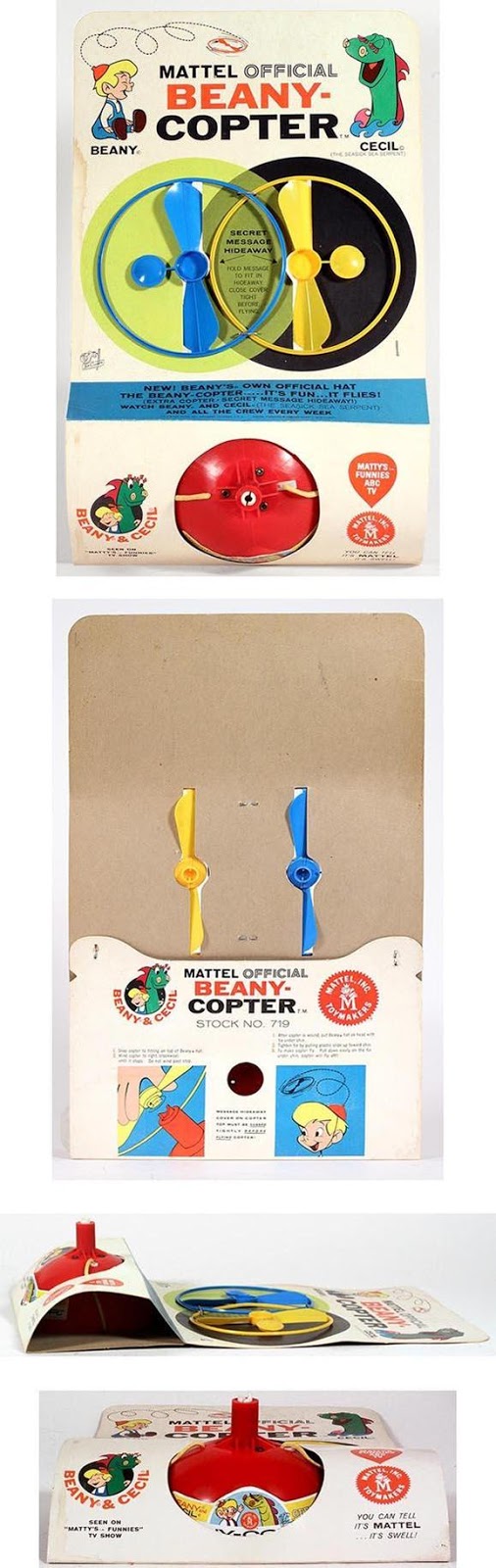
One luxury of my childhood, though, was that for my birthday I got an official Beany-Copter.


Now, do you see that hollow space in the center of the propeller?  The propellers originally had caps that fit over this little cavity.  This small hollow space was to put secret messages into.

 
You set the propeller onto the top of the hat and turned it clockwise two or three times.  There was a ratcheting spring inside, and you could hear it click-pop every quarter-turn or so.  Then you put your Beany-Copter on your head and pulled the chin-string.  This released the propeller, which zoomed into the air and probably landed on your neighbor’s roof, never to be seen again until the next windy day.


This merchandising card gives you an overhead view of the cap -- the white thing in the center of the red was where you put the propeller to wind it up.  And you can clearly see the hinged cap for the top of the “secret message compartment.”

 
I can still remember the zip-click-whir sound made when you had your Beany-copter on and yanked the string to let the propeller go!

 
Here’s a link to a Beany-Copter TV commercial:


And, yes, children, it was typical to have commercials that ran for one full minutes, not ten or fifteen seconds.

Monday, March 11, 2013

Part the Second


            I was nine or ten when I first caught the Get Smart bug.  It was witty, sarcastic, and all about spies.


And for some reason, I don’t know why, Hymie the robot caught my attention.  Maybe because he was so literal in following instructions, and this struck me as silly.  If you were in a hurry and told Hymie to “shake a leg,” he wouldn’t walk faster -- he’d stand there on one leg while shaking the other one.


For some reason, I wanted the other kids at school to think I was a robot, like Hymie.  So I took a piece of paper and drew a (very inartistic) sketch of my left arm, showing various freckles.  Then I labeled the  freckles as if they were buttons.  This is a greatly improved version of a third-grader’s sketch.


Then I told Mom that I was going to leave some copies of this diagram out on the school playground to make other kids think I was a robot.


My mom showed great composure by pretending to go along with this scheme and seemed to take this stupid idea as if it were seriously to be considered.


Nowadays I can’t even count the ways that this was silly or dumb or what-have-you.  The thing was drawn in pencil by a second- or third grader.  Not too authoritative, huh?  Also, if I remember right, I didn’t even write my name or any other ID on the scrap of paper.  So how could kids know WHO was supposed to be the robot?

 
It’s remembering goofy things like this that brings home to me the saintliness of my parents.


Monday, March 04, 2013

Welcome Back, with MA-01 - The Themes from U.N.C.L.E.


Here's the first in a series of compilations of versions of Jery Goldsmith's classic theme to The Man from U.N.C.L.E., along with songs ABOUT the show, and songs reflecting its popularity an influence in pop culture from the 1960s to today.

These are the tracks:

1 First Season Main Title revised Original television score 0:55
2 First Season End Title Original television score 1:14
3 Man from U.N.C.L.E. Theme Roland Shaw and His Orchestra 2:36
4 “The Deadly Decoy Affair” Main Title Original television score 1:13
5 The Man from Thrush Lalo Schifrin 2:55
6 Roulette Rhumba Lalo Schifrin 2:06
7 Man from U.N.C.L.E. Theme Dick Hyman 2:29
8 To Trap a Spy - Meet Mr. Solo-End Title Original film score 1:54
9 Man from U.N.C.L.E. Theme The Man from U.N.C.L.E. and Other TV Themes 1:43
10 Illya The Man from U.N.C.L.E. and Other TV Themes 2:30
11 Night People The Man from U.N.C.L.E. and Other TV Themes 2:37
12 Second Season Main Title (arr Lalo Schifrin) Original television score 0:36
13 Second Season End Title (arr Lalo Schifrin) Original television score 0:48
14 Man from U.N.C.L.E. Theme New Original TV Themes 3:09
15 Man from U.N.C.L.E. Theme Hugo Montenegro 1:59
16 Man from U.N.C.L.E. Theme Al Caiola 2:00
17 One of Our Spies Is Missing Main Title Original film score 3:07
18 Third Season Main Title (arr Gerald Fried) Original television score 0:30
19 Third Season End Title (arr Gerald Fried) Original television score 0:38
20 Man from U.N.C.L.E. Theme Teddy Randazzo 1:33
21 Man from U.N.C.L.E. Theme The Challengers 1:38
22 One Spy Too Many Main Title Original film score 2:49
23 “The Candidate’s Wife Affair” Main Title Original television score 0:28
24 Man from U.N.C.L.E. Theme The Jazz All-Stars 2:07
25 The Girl From U.N.C.L.E. Main Title Original television score 0:33
26 The Girl From U.N.C.L.E. End Title Original television score 0:39
27 The Spy in the Green Hat Main Title Original film score 2:08
28 “The Five Daughters Affair” Main Title Original television score 0:41
29 Man from U.N.C.L.E. Theme Billy Strange 2:28
30 Fourth Season Main Title Original television score 0:31
31 Fourth Season End Title Original television score 0:36
32 The Karate Killers Main Title Original film score 0:29
33 Man from U.N.C.L.E. Theme Swingin' Themes for Secret Agents 2:21
34 The Helicopter Spies Main Title Original film score 2:02
35 Man from U.N.C.L.E. Theme The Man from UNCLE Cult TV Classics 2:41
36 Return of the Man from U.N.C.L.E. Main Title Original film score 1:17
37 Man from U.N.C.L.E. Theme Man or Astro-Man? 1:31
38 Love Ya Illya Alma Cogan 2:27
39 Man from Uncle Moskow 3:30

This first compilation tried to collect most (if not all) of the various on-air versions of the theme. As an example, there were at least two versions of the sax riff in the third-season's opening credits.


Link September 2015

See ya!

Thursday, February 28, 2013

More Intriguing Amazon Suggestions

Amazon's "suggestions" algorithms sometimes leave me bemused.


Do you think they are trying too hard?  Maybe it makes a strange kind of sense....

You see, a year or two I added Fallout Shelter: Designing for Civil Defense in the Cold War (Architecture, Landscape and Amer Culture), by David Monteyne, to my Amazon "wish list."  This is not because I want to build a hideout, but because this volume looks like a cornucopia of Cold War and "retro" visuals.  Thes kind of graphics that I love.

I guess it's a case of misunderstood intentions.  If I truly wanted to build a shelter, then I might also be interested in buying all of these first aid supplies.  After all, a Doomsday Prepper would want his First Aid Kit stocked, yes?  With skin staples?  OUCH!

Not me, I just like to look at the pictures.

Tuesday, February 26, 2013

Book Review -- Enemy of the Truth by Sherry Fiester


Sherry Fiester is a forensics expert who has turned her attention to the known facts in the murder of President Kennedy.  I was honored and pleased when she asked me to read and review her book.  Here's that review....


            Enemy of the Truth is a fascinating look at some of the “myths,” or perceived truths, about the assassination of President John Kennedy.  To the extent that “myths” – untruths – are held or believed by society at large, these fallacies are “Enemies of the Truth.”  The book’s subtitle tells you Sherry Fiester’s emphasis – a forensic look at the crime.
            The eight main chapters examine some of these “myths” and pretty much wipe ’em out.  Fiester’s style may come across in places as dry or dispassionate, but that’s to be expected when you’re reading about technical stuff like parts of the human skull and bullet fragmentation.  The actual subject matter will hold your attention without the need for chatty narration.
            The first chapter examines the mistaken idea that the Dallas, TX police followed correct procedures in investigating the shooting of the President.  Compared to today’s standards such as digital photography and DNA sampling, many of what the DPD should have done, according to their own rules, seems pretty basic and straightforward.  But even basic protocols were flubbed or ignored, such as a complete photographic and drawn-to-scale survey of the Book Depository’s sixth floor.  Even the so-called “sniper’s nest” and the rifle, when discovered, were not documented in situ before they were moved.
            Fiester quotes extensively from the textbook protocols that in 1963 were required for a professional and legally valid crime scene investigation.  And in nearly every way, the behavior of the investigators falls short.  Everything from the bullet casings (not photographed or marked to preserve chain-of-evidence) to boxes by the window (moved and arranged several times by ungloved hands) demonstrates a cascade of failures.
            Now, in this chapter Fiester lets pass two of the things I've always harped on.  The first report of a rifle’s discovery on the sixth floor described a Mauser, not the Mannlicher-Carcano which supposedly belonged to Oswald.  Does this mean that there was a rifle switch-out?  Also, in her discussion of the “paper bag” that Oswald supposedly used to smuggle the rifle into the building, she doesn't mention the well-documented fact that the rifle and bag were too long to have been carried between Oswald’s palm and armpit, as Warren Commissioners would have us believe. 
            Chapter Two describes the science and research behind sound localization, and demonstrates how easy it is for somebody to misplace the source of a sound.  You may honestly think that a sound came from such-and-such a place – but several factors may act, singly or in combination, to mislead your ears.  Examples are:  your location within a certain landscape; your distance from the sound; any refractive surfaces; and even the position of your head.  All can influence your perceptions.
            The next chapter discusses the controversies surrounding a single frame of the Zapruder film, Z313, which depicts a red cloud or mist in front of JFK’s forehead.  This scarlet fog appears ONLY  in this one frame, and a few researchers have held that this crimson haze appears and then vanishes much too quickly to be an actual event caught by the camera.  At least one book cites this cloud as “proof” that the Zapruder film has been altered.
            But Fiester explains the facts behind a phenomenon called “backspatter,” about which she knows as part of her expertise in forensics.  The red flicker seen on frame Z313 is an absolutely accurate depiction of backspatter, and what forensically you SHOULD EXPECT TO SEE following a shot to the front of the head.  Backspatter appears and dissipates in an amount of time much briefer than a single Zapruder frame, and that’s why we see it in mid-dissipation for only one frame.  It’s not a red blotch that was painted onto the film by forgers, as some have said.  It’s what is to be expected as the result of a front headshot.
            Chapter Four talks about some witnesses’ claims that the President’s car slowed to a crawl or stopped outright (perhaps to make it easier for an assassin to aim and fire).  This idea can be laid to rest with some of the reasons explained by Fiester in this chapter.  She explains some of the research behind the mind’s perception of time and how, in crisis situations, the passage of time can be felt to speed up or conversely “stand still,” despite the objective passing of seconds, minutes, and hours.  Furthermore, none of the extant films depicting Dealey Plaza show a car stop, or give any indication of having a car stop edited out.  There are multiple video sources for various parts of this crime.
            The next chapter dissects the myth, held by some since the day of the murder, that “Ballistics Prove One Shooter.”  Fiester lays out some of the many problems facing somebody who wants to believe such a thing – because science dispels the possibility.  Examinations of various recovered bullet fragments and casings don’t show them to have been fired from the same gun – or even the same KIND of gun.  Not even Neutron Activation Analysis can match some of the fragments with each other or with the nearly-whole bullet that supposedly passed through JFK and Governor Connally.  These inconclusive test results were withheld from the Warren Commissioners at the time.
            The sixth chapter really rumbled my cage when it disallowed the Grassy Knoll as the location of a shooter.  Like many folks who believe that this murder wasn’t undertaken by one man in the TSBD, I’ve agreed with the various eye- and ear-witnesses that something was going on behind the wooden fence atop the Grassy Knoll.  But Fiester first determines the location of JFK’s head in relation to the limousine and thus the street and Plaza.  Working from there, she examines the locations of JFK’s wounds – all on the right side of his head – and points out that a shot from the right would have exited on the left.  But the left side of the President’s head, according to doctors and witnesses, was undamaged.  The fence atop the knoll was almost perpendicular to the President, and therefore could not have been the origin point for the fatal headshot.  A more likely location, as indicated by the wounds, would be the triple overpass on the opposite side of Dealey Plaza from the infamous Knoll.
            Grassy-Knollers like me can always believe that a shooter was back there, but that he missed!
            Next Fiester tells me something else that I didn’t know – that the concept of deducing bullet trajectory by examining the beveling (angle of chipping) in the bone is an outdated idea that has been shown not to be accurate.  Being a ballistics expert, she should know!  Evidently there have been so many instances where the beveling angle does not match with known circumstances that the whole doctrine of trajectory-by-beveling has been discarded.  There have even been times when inner and outer beveling has been encountered in the same wound!
            In presenting her case against the Grassy Knoll and for the Triple Overpass area, Fiester jogged my memory and I flipped back to Chapter Two, in which she described the unreliability of sound location by “ear witnesses.”  However, here in Chapter Six, she quotes several people who reported hearing shots that seemed to come from the Overpass area.  The effectiveness of this testimony is somewhat diluted when you remember how in Chapter Two the author showed how unreliable “ear witness” testimony can be.
            Chapter Seven talks about the common belief that there were two headshots, based on the observation from the Zapruder film that JFK’s head moves slightly forward just before jerking rapidly backward from the final bullet strike.  Such a movement seems contrary to common sense, but our forensics expert explains once again, that such a thing is actually to be expected.  Fiester quotes several sources, ending up with the statement that “the forward movement of Kennedy’s head followed by a rearward movement is consistent with a single gunshot to the head from the front.”  So, the Zapruder film shows just what a forensic examination expects it to show:  a tiny forward motion and an almost instantly dispersing backspatter.
            The final myth, Chapter Eight, “The Single Bullet Theory,” is to me a nearly slam-dunk of a topic.  But then, I’m one of those “assassination nuts” with several dozen books in my library on the topic.  Some folks reading this book might not know the doubtful origins of the “Magic Bullet,” Commission Exhibit 399.  Or that the bullet fragments removed from John Connally’s body weigh more than the amount missing from the bullet.  Or that the bullet now known as CE399 was found in Parkland Hospital, on a stretcher known NOT to have been occupied by Connally.
            Anybody who looks even a half-inch into this matter can see the unbelievability of Senator Arlen Specter’s half-baked suggestion, “The Single Bullet Theory,” which was introduced after the Commission found that Oswald’s rifle couldn’t fire fast enough to have launched all of the bullets then known to have been fired in Dealey Plaza.  Just looking at photos of the President’s shirt and suit jacket shows that the bullet hit him in the back, towards the bottom of his right shoulder blade, and not in the back of the neck, as required by the Single-Bullet Theory.
            Fiester then proceeds to decimate the “official” autopsy report for sloppiness and the changes made to it.  Connally’s wounds are also enumerated, raising the possibility that his injuries alone might require the action of more than one bullet.
            And it’s pretty sad to realize that various FBI and other investigators could not even identify the bullet now known as CE399 as the bullet originally found at Parkland Hospital.
            Now, the final part of the book, a section called “The Witnesses,” is for me a delightful change-of-pace.  In this section Fiester tells of her meetings and interviews with various witnesses in the JFK murder case.  Unlike the rest of the book, the writing here is not scientific and clinical; it’s warm and engaging and sympathetic – a great way to balance the hard science in the earlier chapters.
            I really enjoyed this section because Fiester is able to take off the analytical scientist’s hat and talk to these folks as people.  It’s refreshing to end the book with a feeling for the personalities of the witnesses:  Marina Oswald; Bill Newman; Bobby Hargis; Robert Frazier; Beverly Oliver; and Aubrey Rike.
            Through these personal encounters we get a more intimate feel for Fiester herself, her empathy for the witnesses’ pain, and her frustration in confronting an unresolved call to justice.
            All told, Enemy of the Truth told me plenty of things I didn't know about the murder of JFK – and that surprised me!  This book is proof that not all of the questions about JFK’s death have been answered.  Some of the right questions haven’t even been asked!  But Enemy of the Truth does a fine job of shattering some of the myths that have stood in the way.

You can buy Sherry's fine book at her website.

Friday, February 22, 2013

Rorschach: The Early Years

I don't know if it's good news or bad news to inform you that this Rorschach-in-training is not my child, but MY GRANDKID.


Ordinarily Araya Sunshine is a normal little two-year-old who enjoys playing with blocks or, along with her cousin, exploting new avenues of mass transit.

But in times of trouble, the gloves go on, and a new persona takes over....


You don't want to make her angy.

All original content
copyright
© by Mark Alfred