Email me with comments or questions to msuperfan1956@gmail.com – note that comments sent through Blogger DO NOT allow a personal response.

Thursday, December 09, 2010

Talking to the Author of Kennedy Must Be Killed

Well, I've chatted a bit online with Chuck Helppie, author of the book just reviewd in the previous post.  Here are my notes, then his, then mine, then his reply.  As you can tell, he seems like a fine, insightful guy.  You should read the book for yourselves!

I wrote,
On Wed, Dec 8, 2010 at 5:51 PM, Mark Alfred wrote:


Dear Mr Helppie,


I just finished your book, and enjoyed it. If you would like to see my review, please check out my blog entry that I just posted, http://markssuperblog.blogspot.com/2010/12/book-review-kennedy-must-be-killed.html


You did a good job of making the story believable as having happened in one guy’s life story. Darn it, in my review I forgot to mention that I liked the surprise revelation of who the Preacher was!


Anyway, I just wanted to share with you that I enjoyed the read. My copy came in the mail Monday afternoon, and I just wrapped up the last pages.


So, how many assassinations books do YOU have? Probably a lot more than my 81.


Thanks again for the thought-provoking read,


Mark Alfred


He replied,
Hi Mark,


I am more than a little embarrassed that you were able to read my entire book AND write a terrific review in forty-eight hours and yet it took me almost sixteen hours to respond to your very kind note! (I didn't get home until late last night.)


I'm glad you enjoyed my novel so much. Your review was outstanding in terms of delving into some of the themes I wanted readers to recognize and ponder. There was not only a power struggle between the Yankees and the Cowboys but also between the Kennedys and the Eastern 'Old Money' power establishment. (When you peruse the roster of the CFR over the decades you are struck by how few Kennedy insiders are represented.)


I'm also extremely pleased that nothing in the novel "rang false" for you. I tried to be painstaking in my approach for that very reason. I wanted my readers to finish my story and then decide (as you did) whether or not this explains many of the assassination's mysteries and contradictions.


I don't know if you've been to my website (www.kennedymustbekilled.com) but my complete bibliography can be found there. I haven't counted my assassination books recently but I would guess the number to be 250+. You can compare my list to yours and if I'm missing something you recommend, please let me know.


As far as your "pet peeve," I wanted to say that although I'm disappointed I didn't get a perfect 100, I'll happily take a 98. (That's still an 'A+' in my opinion.) That "pouring" mistake on page 421 vexes us as do a few others. My publisher told me no book is perfect, and as hard as we worked in proof-reading it prior to publication, we still found a few errors that slipped through. My wife is a retired AP English teacher and with the assistance of a former colleague, they "pored" over the novel in the editing and copyediting process. I gave them a manuscript with 326,000 words and they did a phenomenal job as they managed to whittle it down to only 258,000. (My wife said that if there is a Hell and she ends up there, the Devil will undoubtedly give her an un-ending pile of manuscripts to copyedit for eternity.)


I plan to spend time this evening going back over your previous blogs to see your other reviews. Once again, Mark, thank you very much for what you've done. My best hope for other readers to discover and enjoy my story is through readers like you.


Best wishes,


Chuck


P.S. - Patrick's story spans the period from 1947 to 1978 (not 1976 to 1978). However, I'll still give you a 100 out of 100! CH

My reply,
Thank you for your friendly and fun reply. I graduated with an English Bachelor’s, spent two years as a proofreader/copy editor for an educational publisher, and DID proofread my review before hitting “publish post” -– and as you can see, was shown up by human frailty! (mine that is, on the dates covered in the book)


Yep, any kind of possible explanation for the murder has to cover the bases you did: organized crime; doubles of Oswald; military/CIA displeasure with a certain “reckless youth;” and, KEY in my opinion, the fact that insiders in several government agencies did so much, AFTER the crime, to push the covers over the heads of America (vide Horne’s books).


An example of that would be the (probable) disassembly of the “murder rifle” and taking part of the barrel assembly (I think it was) into the funeral home to place Oswald’s dead palm print on a part of the gun that is covered up when assembled.


Anyway, although there is no justification for the murder (or any flat-out murder), you did a bang-up job (pun intended—JFK “banging” lots of gals) of depicting a pretty creepy personal life for the guy in the limo, and his ilk.


And I seethe that smug, self-justifying folks (in any generation) think they have the right to decide facets of other folks’ lives because the Upper Crust Knows Best. Or the Dirty Neck, if you want to use the Cowboy-Yankee allegory.


Although (as you can tell from my blog) I am more of a DC Comics guy than a Marvel guy, Stan Lee summed it up well in an early issue of Spider-Man when he said the now-clichéd words, “With great power comes great responsibility.” The moral choices that for you or me might involve cutting somebody off in traffic versus letting them in front of you, to another might mean pulling a trigger or dropping a bomb. Or cheating on your wife, or giving up drinking (to characterize two recent presidents).


I could rant for hours, but let me just say that I liked your book and was disturbed by it too (some of the thoughts or ideas) –- as you intended! (smile) Thanks for the kind reply.


In the long run, we must have faith in God’s eternal justice, while we do our best to do what is right in our own lives.


Thanks again for your time,


Mark Alfred


And Mr Helppie's final note,
I LOVED this response from you! Your passion really comes through in a very engaging way and I can see why your blogs are so popular with your readers.


I grew up a DC Comics guy 100%. My favorites were Superman, Batman, Green Lantern, and the Flash. (Though I also did enjoy Justice League of America.) Add in Mad Magazine and I was a pretty happy kid. That's undoubtedly where my strong sense of justice and fair play were formed. I always root for the good guys to win.


Patrick's story has a strong sense of justice and morality in it. I drew upon many elements of Shakespeare and Greek tragedy to craft the plot and the characters. Iago certainly can be seen in Grant.


I meant the story to be disturbing for the reader on many levels so the reader could question what they thought they knew versus what really happened. Lyndon Johnson's background was profoundly disturbing in many ways, but JFK's callous treatment of Jackie was almost too much to deal with. That's why I wanted to juxtapose Pam and Patrick's loving marriage with the contrast of JFK and Jackie.


Stay in touch - I enjoy your insights.


Chuck


So, whatdo you think about the JFK murder, friends?  It still DOES make a difference.

Wednesday, December 08, 2010

Book Review: Kennedy Must Be Killed

Boy howdy, this is an interesting book.

In 1976, a book by Carl Oglesby, The Yankee and Cowboy War, posited that the "old money" fellows of the snooty Eastern Seaboard were, and had been, engaged in a power struggle with the rough-and-tumble "new money" exemplified by the Texas Oil barons and their ilk.  Cowboys and Yankees.

A view of the Kennedy assassination similar to Oglesby's viewpoint is expressed in this novel by Chuck Helppie.

It varies between a third-person "framing" narrative set in the 1978 world of the HSCA -- The House Select Committee on Assassinations -- and the first-person narrative of Patrick McCarthy, a man who dedicates his life to serving his country.

It's up to the reader to decide if McCarthy succeeds.

First off, let's get my pet peeve out of the way, proofreading.  I would give this book a 98 out of 100.  There are only a couple of typoes, along with the sadly typical use of "pouring" (which you do with a pitcher of water) when the author meant to say "poring" (which is examining or studying something).

This is a novel that uses the character of Patrick McCarthy to cover a period from 1976 to 1978 and the American scene.  Without spoiling the particulars of the book, let's just say that McCarthy meets most of the people involved, or suspected of being involved, when the JFK assassination is discussed.

I must say that the story is told in such a way that yep, it makes sense for this person to have been here at this time.  It makes sense at this time for McCarthy to have been at so-and-so location, and to have met a certain person.  To me, at least, the person of McCarthy as a guy trying to do what's asked of him, for his country's sake, makes sense.

I too have had some self-examining moments when I realize how much the things I have intended, have gone wrong.  Not to this extent, of course.

As to historicity:
In my database of 1900+ books I have in my "Fortress of Markitude" here, this Kennedy Must Be Killed makes 81 that I have categorized under "assassinations."  And, yes, I have read them. 

I actually can't come up with anything in my little ol' memory that conflicts with something presented historically in Kennedy Must Be Killed.  Now, I didn't sit down and check anything off a checklist, but nothing "rang false" to me as I read the book.  A heck of a lot of exposition is handled pretty well as discussions between McCarthy and his two college buddies, who take on other rolse in life as time passes.

Now, even this book at 600 pages must necessarily pass over a LOT of the things entailed in the JFK murder.  For some in-depth creepiness, read the five volumes of  Inside the Assassinations Records Review Board, by Douglas P Horne.  Horne was the Chief Analyst for Military Records for the Assassinations Records Review Board.  He has read the records that prove such things as the Zapruder film alterations and the falsified autopsy results, and such -- all things that could be accomplished by the folks described in Kennedy Must Be Killed

So, it's a pretty interesting book, and covers a lot of possible rationales behind the folks who, beyond reasonable doubts, were involved in the murder of a duly elected President.  Mr Helppie does a really good job of presenting WHY these people were able to rationalize such a coup d'etat as service to their country.

One depressing observation I'd like to make is that both the cowboys and the yankees are elitists and fascists.  They feel that we poor plebians exist only to serve the "greater good" of whatever our country requires of us. 

Saddest of all, they think that they have the right to decide what that greater good is.

So, if I've piqued your interest, check out the book!

Friday, December 03, 2010

The Demon Under the Red Sun! (Part Two)

When last we left our hero, he was having trouble lifting a fellow who weighed "only" 500 pounds.

On this world zig-zagging through space populated by troglodytic descendants of its creators, the local sun is red and therefore Supes is S.O.L.  He has been declared an evil magic demon by the leader of the tribe whose runaway teenage lovers were returned to the fold by the Man of Steel.


As we begin Part Two, "The Test of the Talisman," we see a refreshing bounce-back by Superman.  True, he has no super-powers as he faces this mob of cave-man types.  But on the bright side, he doesn't have to pull his punches.  To praphrase Larry Niven, this Man of Steel is longer surrounded by Enemies of Kleenex!  And, indeed, he cuts loose with some of the voodoo-kung-fu moves he learned from his pal Batman.
And when he winds up for a pitch that will clock one of the guys chasing him, suddenly his hand is stuck to a pile of rocks.  The hand wearing Jimmy's signal watch.  This is where we learn that the famous Jimmy Olsen Signal Watch has a stainless-steel casing, for it has zoom-bang stuck to these rocks, which logically means that they are natural lodestones, magnetically attractive minerals.

I do wonder at the science expressed in the idea that supersonic vibrations can overcome magnetic attraction.  But again, this Kal-El is a scientist and the son of a scientist.  Anyway, it makes for a good introduction of magnetic rocks into the storyline, which is what is necessary here.

Overpowered, Superman is locked up in a pen once used to keep large beasts and now filled with their bones.  The two teens he befriended and saved wish they could help, but they dare not violate the tribal taboos.

Here we have the perfect exemplary of a group's reactionary identification and expulsion of "The Other."

Told he must pass three challenges to prove his virtue, the Man of Tomorrow surveys his enclosure.  It's filled with nothing but dirt, and the huge bones of these long-dead animals.  From this, our ever-inventive hero HATCHES A PLAN.

As you can see from this page, the plan to handle the first trial  involves a marksman who could put William Tell to shame.  However, Superman has learned a thing or three from his pal Batman, besides kung-fu-fighting.  What do you think of this shoulder-blade Batarang!

Next up -- the crawling spaghetti monster!  Well, Superman has got it covered.  Notice the horn Supes is evaluating in the last panel of the above page.  An empty horn.  Its hollow properties are like a megaphone.  Hmm.
 Sure enough, the savoir faire of the Man from Krypton is up to the job.  After calling this monstrosity a plate of spaghetti, he was going to shout "Yer mommy wears Army boots!" but that would have required a lot of army boots.  What drove off the beast was the hollow horn held under his arm, which amplified the "zee-zee-zee" emitted by the Signal Watch, which was on the so-casually crossed arm holding the horn.

But now comes the worst trial of all, the Dorito Challenge.

Actually, although the gleaming yellow triangles LOOK like Frito-Lay snacks, in fact they are radium or some other radioactive substance.  Evidently they are ineffective on the natives, but to Superman they are MURDER.

Note that, as with "The Two Ghosts of Superman," the Curt Swan cover art has been appropriated right into the comic story illustrated elsewhere by Al Plastino.

However, Superman has put together another Rube-Goldberg-type of plan.  First off, he remembers that he has well-wishers outside the stockade, the teenagers he saved.  He has them use the round slices taken from trees by the Purple Spaghetti Monster, and mount them as wheels underneath the platform on which he is to be tortured.  Then Jimmy's MAGNETIC watch is fastened underneath.  At a signal, friend Jaymarr holds up a lodestone, whoseattractive force rolls Superman right away from the clearing thus enabling him to "magically" escape.

(Unshown by the art is the seatbelt that tied Jaymarr to a ten-ton log, and which kept Jaymarr from being dragged toward the platform.)

Well, with that, Superman is released, and just-in-time,the zig-zagging planetoid curves back toward a yellow sun.  With his powers restored, our hero shakes the dust of this wacky place from his feet, confident that his demonstration of the principle of the wheel will guide these people back towards science.


One last thing remains for Superman, and that is vindicating the astronaut whose tale of a careening planet started this adventure.  And giving Jimmy back his watch, of course.

Come to think of it ... Recall that Part Two of this tale is, "The Test of the Talisman."  Now that you think about it, that phrase, though intended to refer to the yellow radium triangles, also is applicable to Jimmy's good ol' Signal Watch.  It played a big part in this adventure, and in every trial, its properties proved it a big help to Superman.  I'd say that this talisman (the watch) passed the test!

Well, do you agree with me that this story had its silly moments?  See you sometime next week!

Wednesday, December 01, 2010

The Demon Under the Red Sun! (Part One)

Wow!  Check out the cool cover of Superman 184.  Not only are these people downright murderous, they have bad dental hygiene!  At least, the guy talking on the left side forgot to put in his uppers this morning.

Cover-dated February 1966, the tale inside is "a complete, full-length novel!"  It's written by Otto Binder -- probably after the cover was conceived.  At least, such was a common occurrence in the Silver Age.

I think it fair to say that hardly ANY story could live up to the awesomeness of this cover, by Super-Great Curt Swan.  But, in my opinion, the story is almost the goofiest-ever version of the possibilities hinted here.  And the interior art by Al Plastino is by turn pretty good, and downright silly.

To begin with, an astronaut coming back from space tells NASA of the oddest thing ever:  a planet is zig-zagging through space!  Even the spaceman knows how wacky this sounds.

(By the way, the reason Superman is wearing a watch is because it's Jimmy Olsen's signal-watch which has been given back to Superman for repair.)


Still, Superman has no doubts that our serviceman saw SOMETHING.  And, sure enough, after a game of cosmic tag, the Man of Steel touches down on this odd celestial body.  Given the splash page we saw just inside the cover, we just KNOW that nothing good can come of this.  "Look out, Superman!" we want to yell.


But does he listen to the whispers of caution?  Of course not.  Not only would this be a very short story, but what kind of hero would turn down the chance to explore a new world?

Once he carries out a super-vision survey, Superman discovers that the orb is hollow.  It is in fact a construct, created by an alien humanoid race to rescue their people from the vagaries of a sun grown toxic.  This space wanderer is like one of Heinlein's "Generation Ships."

Only problem is, the people dwelling on the surface have descended into barbarism.  The scientist-caretakers of this great space ark have all died out.  However, by means of a "last will and exposition" left behind by the last scientist standing, our hero learns all of this, just before he stucks a paperclip into an electrical socket to see what will happen.  I mean that almost literally, as you can see from the art.

Wow!  Isn't that an almost psychedelic depiction of Superman's super-shock?!?  I think it looks pretty neat.  And note that captioned arrow in the last panel of the page above.  Accidentally flipping that switch CANNOT be good news.  (Boy, if only we had an Infantino arrow-hand, that panel would be PERFECT!)

Now that he has learned the secret of the wandering world, our hero decides to survey it.  He conveniently swoops along over a teenage couple that is not only marooned at sea, but threatened by a couple of marine rejects from Pepperland.  He rescues the young people and returns them to their tribe.

That's when he is immediately challenged by the tribe's head mugwump as a an evil demon.

And that's where Part One of this novel ends, with Superman no longer feeling super.  Not only can he not lift this "only" 500-pound guy, but his hands don't even sink into the guy's gut!

I hope to continue sharing this tale with you on Friday.

Monday, November 29, 2010

The Persistence of a Folk Song

There's a folk song from the British Isles, called "Lord Randall."  Here are the words of one version:

Lord Randall


"O where ha you been, Lord Randal, my son?
And where ha you been, my handsome young man?"
"I ha been at the greenwood; mother, mak my bed soon,
For I'm wearied wi hunting, and fain wad lie down."


"An wha met ye there, Lord Randal, my son?
And wha met ye there, my handsome young man?"
"O I met wi my true-love; mother, mak my bed soon,
For I'm wearied wi huntin, and fain wad lie down."


"And what did she give you, Lord Randal, My son?
And wha did she give you, my handsome young man?"
"Eels fried in a pan; mother, mak my bed soon,
For I'm wearied wi huntin, and fein wad lie down."


"And what gat your leavins, Lord Randal my son?
And wha gat your leavins, my handsome young man?"
"My hawks and my hounds; mother, mak my bed soon,
For I'm wearied wi huntin, and fein wad lie down."


"And what becam of them, Lord Randal, my son?
And what becam of them, my handsome young man?
"They stretched their legs out and died; mother mak my bed soon,
For I'm wearied wi huntin, and fain wad lie down."


"O I fear you are poisoned, Lord Randal, my son!
I fear you are poisoned, my handsome young man!"
"O yes, I am poisoned; mother, mak my bed soon,
For I'm sick at the heart, and fain wad lie down."


"What d'ye leave to your mother, Lord Randal, my son?
What d'ye leave to your mother, my handsome young man?"
"Four and twenty milk kye; mother, mak my bed soon,
For I'm sick at the heart, and I fain wad lie down."


"What d'ye leave to your sister, Lord Randal, my son?
What d'ye leave to your sister, my handsome young man?"
"My gold and my silver; mother mak my bed soon,
For I'm sick at the heart, an I fain wad lie down."


"What d'ye leave to your brother, Lord Randal, my son?
What d'ye leave to your brother, my handsome young man?"
"My houses and my lands; mother, mak my bed soon,
For I'm sick at the heart, and I fain wad lie down."


"What d'ye leave to your true-love, Lord Randal, my son?
What d'ye leave to your true-love, my handsome young man?"
"I leave her hell and fire; mother mak my bed soon,
For I'm sick at the heart, and I fain wad lie down."


Basically, it's a dialogue between Lord Randall and his mama.  He went out and met a wonderful gal (he thought), but she was an evil gal who poisoned him with "eels boiled in brew" and he has come home to die.
 
In college, in Speech class, I wrote music to one version of the words and performed it.
 
Well, this morning I was listening to some music by The Buchanan Brothers -- you should be familiar with them through the Atomic Cafe soundtrack -- and one of their songs is called "Mama I'm Sick."
 
Mama I'm  sick, I went away...
Mama, I nearly die when I think of that pie,
Oh mama I'm sick ...
Oh why did I roam?
Oh mama I'm sick ...
Mama I'm sick from my head to my feet ...
I went away, like a fool went astray,
I've rued that day --
Oh Mama, I'm sick.
 
Now, do you think that the Buchanan Brothers knew anything about the old English ballad?
 
See you in a few days with "The Demon Under the Red Sun!"

Tuesday, November 23, 2010

Who Can Save Us Now?

This is an anthology of stories about varying aspects of the superhero life.  Some stories are silly, some are serious, some are more "realistic" than others.  Here are a few of the ones I liked the best:

"The Quick Stop 5" by Sam Weller -- can you say "industrial accident"?
"Remains of the Night" by John McNally -- mash "creepy" and "depressing" and you get the idea
"The Meerkat" by Owen King -- I love the origin of the giant Russian Robot
"Man Oh Man -- It's Manna Man" by George Singleton -- what a great superpower!
"My Interview with the Avenger" by Tom Bissell -- if they had interviewed Big Daddy from Kick-Ass (the movie I mean), it might go like this
"Mr Big Deal" by Sean Doolittle -- to catch one, send one
"The Somewhat Super" by David Yoo -- check your local VFW chapter
"Bad Karma Girl Wins at Bingo" by Kelly Braffet -- and also meets her Dad

Some of the tales are OK, some are more "literary" or "serious" -- I confess that they weren't as rewarding to me, though.

All in all, this was a fun read.  With twenty-some stories, this book can probably entertain you.

Friday, November 19, 2010

Book Review: The Supergirls

The complete title of this fun book is The Supergirls: Fashion, Feminism, Fantasy, and the History of Comic Book Heroines.
With chapter titles like "The Queen & the Princess" (Sheena & Wonder Woman that is), "Girls Together (Outrageously)," and "SUPERGIRL & The Ballad of American Youth," you can tell that the author has considered things, and gone farther than an organized list.

One of author Mike Madrid's many interesting observations seems obvious, but it is insightful.  It's simply the observation that male heroes are often *something*MAN, while most adult heroines are still GIRLS, like The Invisible Girl, or Power Girl.

While some might interpret such things as intentional oppression by a demonic patriarchy, Madrid makes the more commonsense observation that, considering who ran the industry -- mostly guys who were in their 40s or 50s -- and their target audience -- boys six to fourteen years old -- then, it's not surprising that this naming "phenomenon" worked out that way.

Personally, having bought and read both of the recent Fletcher Hanks anthologies, I was hoping for more than a mere mention of Fantomah, the autocratic avenger of the Jungle-Born.  But that's just me.

There are fine chapter-head illos by Madrid, who is also an accomplished illustrator and modelmaker.  But you'll want to SEE some of the comics scenes described in the book, so for that, go to the Supergirls Visual Guide, online at http://www.heaven4heroes.com/heaven4heroes/Heaven4Heroes_SUPERGIRLS_Visual_Guide.html .

This is an interesting read, and part of the reason I liked it is that although Madrid makes many points both positive and negative, he isn't snarky about it.  I learned a lot about comic-book gals from the 1930s and 1940s that I didn't know before, and enjoyed myself.

You should buy it, you'll like it!

PS If, on the Supergirls Visual Guide page, you click on the HOME tab at the top, you can see a lot more of Mr Madrid's artwork!

Monday, November 15, 2010

The Two Ghosts of Superman!


This was the cover story of Superman 186, cover-dated May, 1966.  The art was by Al Plastino (with touches by others), and the story was penned by Otto Binder. 


Interestingly enough, both the cover art and the splash-page art represent actual scenes in the story, unlike lots of stories from this era.

As you can guess from this brief glimpse of subject matter, the readers were expected to be familiar with the trappings of seances and crystal balls.

Indeed, the mid60s was a hotbed ofwonder when it came to consideration of the supernatural.  Psychic Jeanne Dixon was in her heyday, having made much "hey" (pardon the pun) over the coming-true of her very hazy "prediction" of JFK's 1963 death in a reading given before the 1960 election.

Space brothers, recently come down from on high to set our atomic policies aright, were all the rage, too, with George King founding the Aetherius society, the Unarians in California, and lots more wackiness.

So eight-to-ten-year-olds were familiar with the whole table-tipping concept when this story opened up with mug Flashy Fisher telling the Daily Planet staff the location of Cap'n Kidd's treasure, just waiting for Superman to dredge it up, "straight from the spirit's mouth, you might say!"

Sure enough, when a skeptical Superman "gets the message" from Clark Kent, he investigates and -- sure enough -- there the loot is!  Supes does the right thing and turns the treasure trove in, to the US Mint, which gives him a share as a finder's fee.  In turn, Supes give most of that dough to charity, with a small percentage going to Flashy for the original tip.

Clark's interest is piqued when  the hood "drops" a business card when leaving with his cut of the dough.  "Sir Seer," eh?  Maybe Superman should pay this guy a little visit.

Actually, it's a subterranean visit!  Aftger digging underground to the psychic's digs (get it?), the Man of Tomorrow super-spies on a seance, whose target spirit this time is Jesse James.

Boy, is Superman puzzled when he can't find a trace of trickery!  That's right -- no confederate dressed up in luminous paint -- no dummy on a wire.  As Cecil the Seasick Sea-Serpent would say, "What the HECK!?!?!"

Next, the nonplussed Man of Steel goes to the location indicated by the ghost, and finds gold!  He quickly melts the gold dust into bars and ferries it to a government vault, again cutting in the shady character from the seance with a share.

Well sir, Superman doesn't know up from down after that.  He calls a news conference and endorses Sir Seer's 100-per-cent track record.

Soon after, Sir Seer holds a seance for the press, attended by Lois, Clark, and Lana Lang for her job at WGBS-TV.  The guy takes requests!  So, in a trice, Queen Isabella of Spain appears, to tell the gathered folks that some of Columbus's treasure is hidden -- gusss where?


By now, we're thinking, "Give me a break!  How could there be loot in the Batcave?"

Read it and weep!

Ths bottom panels of this page let us in on what we susupected -- that somehow this whole psychic gig was a fraud.  But why?  What kind of crooks would give away most of a treasure to the government?  And don't forget that Superman himself was stumped.

But keep reading.  These guys are saying that SOME of the phenomena were faked, but NOT Queen Isabella!  Ol' Sir Seer must REALLY have some pull with the ghostly crowd, after all!  "I had genuine pychic powers all along, and didn;t know it!" -- Sheesh, bragging much?

So, it's back to the psychic we go with Lana and Lois, but his time with Superman, not Clark, playing the quizzical role.

And that's when the scene depicted in the tale's splash page comes true.  The spirit of Superman's father Jor-El appears, and warns Superman that he is doomed, doomed, DOOMED!  It turns out that Supes and Supergirl are scheduled to scheduled to test some nuclear weapons at his Fortress of Solitude.  Jor-El says nix on that, or else there will be a couple of more Kryptonians in The Great Beyond!

Nevertheless, our hero resolves to go on with the task, and -- as you can see above -- at the appointed time, either a huge explosion rocks the Earth, -- or -- Lois and Lana are rehearsing a new version of the Frug.

To make sure, the gals visit Sir Seer, who reaches into the etheric hat and pulls out TWO ghosts, not one!

Now, let's refer back to the beginning of this review, when I mentioned that the art was by Al Plastino, "with touches."  Look at the first panel on this page for an example of what I mean.  Do Lois and Lana's faces look like Plastino girls?  NO!  Do they look like Kurt Schaffenberger girls?  YES!

I have no proof of this speculation, but if DC would require Schaffenberger to supply "pretty girl" heads in Curt Swan art (viz. "Superman Red & Blue"), which we know DID happen -- then isn't it possible that the same thing happened here?

One thing we DO know is that the LAST panel on this page isn't from our pal Al; it is the same Curt Swan art as the cover.  Yes, they shrank down the same drawing!  While this DID happen in some other Superman tales, it by no means was a common occurrence.

Not only do the ghosts appear, they both confess that Clark and Superman were the same, then merge together!  The cat of the secret identity is out of the bag now, ladies!

Well, with the Man of Steel gone, crooks whoop it up in Metropolis.  We read several panels of "Crooks Gone Wild," until -- finally, as we knew he would -- Superman reappears and starts snapping up crooks left and right.

In the denouement, we learn the rest of the story ...

While he was originally bumfuzzled by the whole spiritual thing, eventually Superman tumbled to the trick.  I can tell you, a plot involving 3D projections bounced off of space satellites and then appearing in a darkened room, without a receiver for the image, is a little beyond even the theoretical pale for me.

Neveertheless, when our hero got wise, he himself came up with ways to fake Queen Isabella and Jor-El's appearances.  Super-magnified thumbnail tattoo, anyone?  The  Kidd and James treasures had been planted by crooks to "salt the mine," so to speak -- a fancy way of money-laundering, by forging old treasure through melting down recently stolen valuables.

Jor-El's message of doom laid the groundwork for the "disappearance" of Superman and the free rein of crime in Metropolis.  Superman had hijacked the gold-laundering plot to bring tons of crooks out of hiding and freshly incriminate themselves with this crime spree.

And the ground-twitching? what was the coust of that?  The good ol' SUPER-HEAD-BONK!


What good is a Silver Age comics tale without a good ol' Super-Head-Bonk once in a while?

Now, all that's left is a final panel where Clark explains to Lois how he and Superman cooked up the "Clark's-Ghost-Is-Superman's-Ghost" scene just to tease her and Lana about their Secret Identity suspicions.


Read that last line from Clark.  That's not the Superman I know and love, kids!  That's a sociopath!


Saturday, November 13, 2010

CBS's "Psycho" Trend

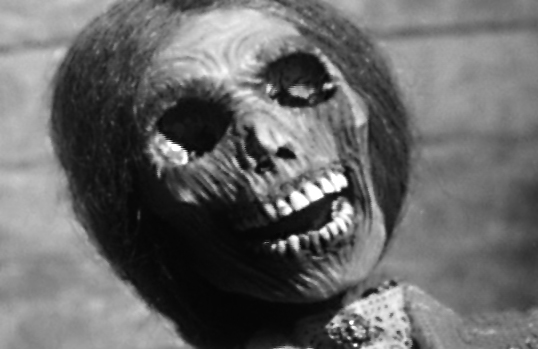
Has anybody noticed CBS's penchant last week for referring to Alfred Hitchock's Psycho film?

On Wednesday night's Criminal Minds, that was the whole plot twist of the episode.  Robert Knepper is kidnaping, mutilating, and murdering girls to try and recaptured the beauty of his mother, faded film star May, played by Sally Kirkland.  There is a lot of give-and-take dialogue between Knepper's character, named "Rhett," and May.

When the police show up, Rhett and May surrender to the FBI and squad cars outside.  The sequence is shot from many alternating points-of-view.  One of these POVs is Rhett and May descending the front steps of their brownstone, like Gloria Swanson ready for her close-up.

It's only in one of these POVs that we get the clue that Mummy is -- er, a mummy.  Yep, May has been a silent partner all along while Rhett committed the murders.

Shrieking violins, anyone?


Now, on Friday, November 12, we saw a CSI:New York epsiode called "Scared Stiff."  A death in Central Park leads the investigators on a merrie chase which leads them to a closed-down funeral parlor.  As they wander through the basement where the processing rooms are, Detective Don Flack (Eddie Cahill) makes a comment like, "If we find a little-old-lady body in a black dress in a rocking chair, it's every man for himself."


Do you suppose this is a simple coincidence?   If, on  Sunday night's CSI:Miami, Horatio visits "Norman's Baits Shop," it's every man for himself!


Friday, November 12, 2010

Awkward Phrasing 101

Here we have a book by Michel Flynn, In the Country of the Blind, about conspiracy theories and secret societies and attempts to influence history by identifying key events and giving them a little nudge to provide the desired outcome.

Unfortunately, this interesting idea is handled competently, and no more.  At least in my opinion.

There are a few instances when the style of writing simply reaches out of the book and slaps you in the chops, really ruining the story experience.  A novel like this wants to involve you in its tale and characters.  It's a real detriment when something criminally clumsy reminds you that this is all a book that you can put down at any time.

Here is a very laughable, and truly pathetic example.  Here we have the situation of a creepy fellow who is being held at gunpoint by an equally creepy lady.  She is his superior in one of the several secret string-pulling conspiracies featured in this book.  She is also (like the guy) twisted in a sexual manner, too.  Having caught the guy betraying the company, she holds him at gunpoint and orders him to sexually service her.

Here is the deathless prose in its context on page 330:

Just when you figure out that Kennison has an erection, and that his female boss desires to avail herself of it, we find out that he "stiffened" when she points a gun at him.  I thought he was already stiff  ?!?

And the next sentence takes you from humor to sheer disgusted mourning for the sheer dopiness.  "She UNCOCKED the gun."

Well, now that I have given you a reason not to buy this book on Amazon for a penny, I'll leave you until Monday, when we will meet "The Two Ghosts of Superman!"

Monday, November 08, 2010

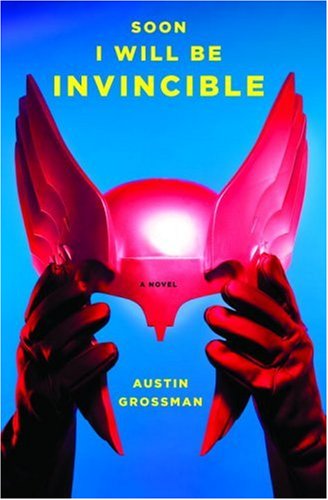
Soon I Will Be Invincible

This is a delightful read.


It's told in two first-person POVs.  The first is the tale of the greatest criminal genius of all time, whose first name was once Jonathan, but whose official moniker is Doctor Impossible.

The good Doctor gives us a fine insight into how obsession can become commonplace, how dedication to a certain idea can seem mad.  But it's only such madness that can lead to the power.  The power to move the Earth.  The power to build an island hideaway from which to laugh at the Earth's heroes.  The power to sneak into the Supers' own hideout, and laugh at them therefrom.

Ha ha, to LAUGH at them!

...Ahem.  The second POV is the tale told by Fatale, a robo-Bionic Woman kind of character, who honestly doesn't remember who she was before she woke up with -- er, augmentations -- after a terrible traffic accident.

Fatale's story and thoughts give us the other half of a world where Supers and their Nemeses are real.  We have the attempted government co-option of heroes, the effect of Magic on Heroes, the history and future of the world, invasions from space -- AND THOSE ARE JUST PART OF THE BACKSTORY,

Excessive capitalization aside, this is a fun book that will appeal to folks who like Watchmen or Mayer's Super-Folks, or who have just seen Megamind.

And, you've got to love the chapter titles, too.

Thursday, November 04, 2010

Vulcan Doomed -- Film at Eleven

OKLAHOMA CITY (Disassociated Press) -- Once a fine polystyrene character from Ben Cooper, a once-proud Mr Spock mask disappeared into the garbage with bruised dignity this past Halloween 2010.


Once a proud celebrant of diversity and jigsaw-puzzle belt buckles, Spock mask took his final retirement with dignity and resignation.

"It is regrettable that my owner did not perform sufficient preservatory skills," were the final telepathic thoughts from the mask as it disappeared down the street in the garbage truck.

Still, we will always have this memory of the masks's final moments:

Tuesday, November 02, 2010

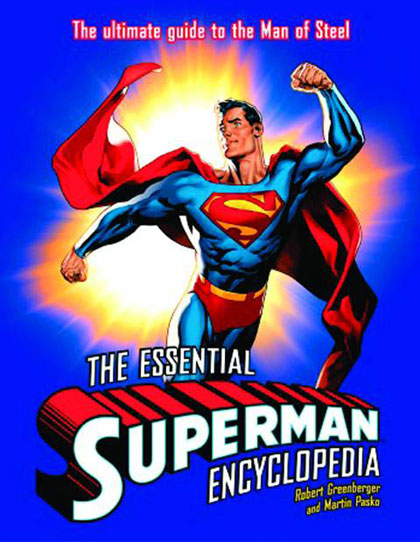
The Essential Superman Encyclopedia

This is a fine book with some rough edges.

It’s modeled on Michael Fleischer’s The Great Superman Book, first published in 1978. Here we have a cavalcade of entries, from J Wilbur Wolfingham and X-Plam to Adoria and Bizarro.

While in the introductions, authors Greenberger and Pasko apologize for not being 100% inclusive of EVERY super-fact, believe me this tome is exhaustive enough for most purposes.

The authors delight in giving references for every listing of things like suburbs of Metropolis or banks in Smallville, and other brain-bending facts. Of course, that’s the way we like it!

My main negative observation about the book is simply an inelegant writing style in some entries. Dozens of times – and I do mean DOZENS of times -- the phrase “wound up” is used to, er, “wind up” a description of a character. My most un-favorite example is somebody who “wound up shot.” That’s all; they just “wound up shot.”


I only came across one FACTUAL error. There may be more, but the only one this fanboy noticed is that the entry for Streaky the Supercat gets HIS gender wrong.

I don’t know if it is a case of not reading the sources or what, but as you can read and see, the book calls Streaky both “her” and “him” in the same entry. As you can further see from this comic panel (that I just scanned) from Action 261, Streaky is a tomcat, not a Thomasina.

The book has plenty of B&W illustrations and two color insert sections. My opinion on the color sections is simply that more of the art should have been from the first 30 or 40 years of Superman’s existence. And why does he look like a girly man on the cover?
The artists should have been credited, within the text, whenever possible. A simple numeric code or initials would have been great. Instead, there is simply a listing of the name of every artist whose work appears in the book.

Of course, there is neither any listing of the WRITERS of any of the stories that make up “the texts” or “the accounts” that the entries are based on. You wouldn’t really expect such a thing either, I suppose.

But – I was thrilled – indeed, laughed with joy, when I read the entry for Kurtiswana! I had forgotten this one. Other writers and artists may have been memorialized in the Superman canon by having streets or businesses named for them, but only my favorite Super-Artist, Curt Swan, had a COUNTRY named after him!

One sad attribute of this book is how hard it was for Greenberger & Pasko to even try to “tell the story” of some of these characters, given so many retro-continuity tangles and hand-wavings and ignoring of characters’ attributes in earlier appearances that have happened in comic books.

The authors have done a fine job, given the scrambled histories of characters such as Power Girl, and things like Pocket Universes, and the like.

So, if you care about the Man of Steel, get this book. Of course, I don’t know how many of you would simply sit down and read it, cover-to-cover, as I did. But it belongs on any Super-bookshelf.

After you’ve bought and read Fleischer’s book FIRST.

Monday, November 01, 2010

Saturday, October 30, 2010

Bigfoot in Oklahoma Again

When I was a kid there was an area a few blocks west of a friend's house that was overgrown, muddy, and full of twisting trails made by the big kids who snuck around after dark to smoke or drink.


We called it "the Flats."  The whole area was maybe only a half-mile across at its widest point, but to us 11-year-olds, it seemed like an immense jungle.

Whenever I hear about a Bigfoot sighting in Oklahoma, I think of the critter crashing around in "the Flats," and I'm glad I didn't meet him there.
All original content
copyright
© by Mark Alfred